


(PREVIOUS EPISODE CAN BE FOUND HERE)
The waiting was the worst part.
Not panic. Panic, at least, had the courtesy to give a body something to do—run for a boat, a cellar, a god, a knife, or whatever else your shaking hands could grab before the world ended. Waiting just squatted next to you, fat and smug, breathing onion stink in your ear, counting out your heartbeats like a miser with coins, making damn sure you heard every last one.
Horlo crouched in the root cellar under Orkell’s Inn, wedged in with the stubborn, the doomed, and the sort of folk who’d rather die in their own dirt than run. He peered through a crooked crack in the boards at the street beyond, where moonlight spilled silver over mud and restless trees, turning the world outside into something strange and haunted, like a place he’d only heard about in bad stories. Shadows squatted everywhere, and every twitch of branch or blade of grass made his guts twist tighter, like some invisible hand was wringing him out for supper.
The boats had left an hour ago.
There had been crying and shouting down at the riverbank, people stumbling over crates and children while Marna organized them with terrifying efficiency. The currachs pushed southward downriver toward Borel, carrying those too old, too young, or too frightened to remain. Horlo had tried to climb aboard only long enough to help, but when his mother told him to go with them, he refused.
“I can help,” he had insisted.
“You are helping by living,” Marna had snapped back.
“I’m not running.”
At that, she had pinched the bridge of her nose and closed her eyes as though appealing to gods she no longer trusted. Barbaranna had stepped in then, placing one massive hand on Marna’s shoulder.
“He can watch de cellar,” she had said. “Boy knows de inn. Knows de people. Better than hiding in some boat crying into the river water.”
Marna had stared at Horlo for a long moment before nodding once.
“Stay hidden,” she warned him quietly. “No heroics. No foolishness.”
Horlo promised immediately.
Both of them knew he was lying.
Now he sat among the leftovers. Some were too old to run, some had nowhere else to go, and a few just clung to the place they’d bled for, like barnacles on a sinking ship. The hearthfire spat and hissed, throwing uneasy orange across faces drawn tight with fear and stubbornness. Some muttered prayers to gods who’d never answered before and probably weren’t listening now. Others sharpened knives with the grim focus of people who’d never killed anything bigger than a chicken and weren’t sure they’d like the taste of goblin.
The strangest thing to Horlo was who remained standing.
Arkady Pilsen and Old Margus shuffled out from the back, swaddled in Borelian ranger armor that stank of old oil, cedar, and the kind of dust that only comes from decades of neglect. At first, Horlo almost laughed—these were men he’d known as grandmasters of complaining about weather and wheat, old fools who could argue for hours about grass rot and fishing lines. But now they moved differently, straighter and heavier, like the armor had woken up something dangerous that had been napping under their wrinkles all these years. The steel didn’t fit their bellies or their joints, but it fit their eyes just fine.
The Ranger Regiment.
Horlo had heard stories. The first royal forces to leave the hidden cave settlements after the Horrors faded. Explorers. Scouts. Men and women who walked back into a broken world, unsure if the land itself had been poisoned or haunted by the things that made men disappear overnight. Some said the Horrors were beasts born of darkness and cold; others claimed they were storms of sorcery that could unmake flesh and stone. There was an old tale, half forgotten, of a shattered star that fell in the northern wastes, and from its crater poured a curse that devoured night and memory. Others believed the Horrors were the price of broken promises made by kings and gods, or ancient magic loosed when the world was still young. The ground in some places still trembled on certain nights, and children were sometimes born with silver eyes or voices that echoed with strange harmonies. In old border towns, folk whispered that if you listened closely at dawn, you could hear the Horrors breathing beneath the earth, never quite gone. No one agreed, except on this: whatever the Horrors were, they left scars you could not always see.
Margus caught Horlo staring and grinned beneath his gray beard.
“What?” he barked. “Thought we sprouted old overnight?”
“A little,” Horlo admitted.
Arkady snorted while adjusting the straps on his shield. “Boy, there was a time women across three kingdoms wanted me dead or married. Sometimes both.”
“Still true,” Margus muttered.
Barbaranna entered next, and every conversation in the room stopped.
She wore a patchwork of armor dragged from the inn’s forgotten corners, dust and cobwebs clinging to scale and plate that hung off her like iron curtains. But it was the axe that shut every mouth in the room.
The thing was monstrous.
The haft looked carved from a whole young tree, thick and bent with years, and the stone head was a chunk of mountain sharpened into pure, ugly rage. It could have doubled as an anvil or a tombstone. She hefted it one-handed.
When she set it down, the floorboards groaned like they were considering giving up and letting the whole inn drop straight into the earth.
“Horlo,” she said in her thick Karabekian accent, “vare is jor Mozza?”
“She’s helping at the boats,” Horlo answered, carrying a bucket of water toward Arkady and Margus. “Last I saw, she was at the stables.”
“Your mother is so efficient, I am surprised she is not Narrisian,” Barbaranna grumbled.
The joke earned a few nervous laughs.
Then she turned toward the door, and for one brief moment Horlo saw it.
Fear.
Not panic. Not weakness. Just the careful fear of someone who’d survived too much to ever trust what came next.
That chilled him worse than any wind ever could.
Horlo carried water to Arkady and Margus at the river depot, where they hammered boards over windows and stacked crates into makeshift barricades. The older men drank deeply from the bowls he offered.
“You ever fight goblins?” Horlo asked quietly.
Arkady wiped his beard. “Aye.”
“Ugly little bastards,” Margus added.
“What are they really like?”
The two old men exchanged a glance.
“Smart enough to be dangerous,” Arkady said. “Mean enough to enjoy it.”
Margus leaned against the barricade. “Most folk think goblins are cowards. That’s a lie. Goblins know battle better than most men ever will. They just don’t kneel to fairness. For them, a good fight ends with their tribe fatter and their enemies feeding the worms. Honor’s worth less than a cracked tooth. They prize cunning over muscle, loyalty to their clan above all, and they believe the land remembers every drop of blood spilled for it—yours, mine, theirs.”
Beyond the barricade, somewhere in the moonlit treeline, a goblin chief listened to the far-off sounds of the human defenses. Around him, his kin pressed low to the ground, silent but for the careful click of stone and bone tokens braided into their hair. He tapped his chest with two fingers—a gesture of kin-bound promise—then touched the earth. “Old ground. Old debt,” he whispered in his quick, guttural tongue. The others repeated the words, not as a battle cry, but a reminder. Hunger, memory, and the hope that their lost would not be forgotten moved them forward. For them, this night was not only about taking but reclaiming what had been lost in darkness and blood.
“They stayed above ground during the Horrors,” Arkady explained. “While humans hid in caves and dwarves sealed mountains, goblins fought and survived in the filth of it all. Learned quickly. Adapted quicker.”
“They see all this?” Margus gestured toward the village. “Human towns. Farms. Trade roads. They see thieves moving into land they bled for.”
Horlo swallowed.
“So why attack us?”
“Because that’s what desperate things do,” Arkady said simply.
Margus spat into the dirt. “And because goblins love slaves.”
That darkened Arkady’s expression immediately.
“No creature owns another,” he growled. “Not man. Not goblin. Not king.”
The old ranger’s anger flared so quickly that Horlo finally saw the man he must have been and understood why people once called him dangerous.
Margus nodded toward the darkness. “Remember this, boy. Never underestimate goblins. If they’re stupid, they make up for it in cruelty. If they’re clever, they become monsters. And if they’re both…”
“Burn them,” Arkady finished.
Horlo pulled out his father’s dagger then, trying to look brave as he struck a dramatic stance.
Margus gasped theatrically. “Gods preserve us.”
Arkady raised his hands in surrender. “Too fierce! Spare me, young warrior!”
Horlo grinned, feeling for a heartbeat like a hero in some old tale—
—and then Marna’s voice cut through the night behind him.
“Pointing end out.”
He turned.
His mother stood there watching him with tired eyes.
Horlo sheepishly lowered the blade. “I was practicing.”
“You were posing.”
“Posing can become practice.”
Marna sighed and held out her hand.
Reluctantly, Horlo passed her the dagger. For one terrible second, he thought she meant to confiscate it.
Instead, she whispered something beneath her breath.
The air around the blade shifted.
Smoke—not smoke, exactly, but something pale and glowing, like burning sand or the ghost of a campfire—curled around the dagger before sinking into the steel. The weapon shimmered, just once, and Horlo felt a chill crawl up his spine. Most folk never saw real magic up close. Steel enchanted like this cost lifeblood, and there were stories of mages losing years, teeth, or worse with every spell. Only the desperate or the stupid dared risk it. Some whispered that every enchantment cost a mage something precious: a memory gone, a favorite taste turned to ash, fingers gone numb to touch. Marna’s hand trembled, just a flicker, as the light faded from her knuckles, and Horlo wondered, for the first time, what it took from her each time she did this. What she’d already left behind in the dark.
Then it was gone.
Marna handed it back.
Horlo stared. “What did you do?”
“What did I say?” she countered.
“Pointing end out?”
That earned a small laugh from her. She kissed his forehead.
Then the screaming began.
Not human screaming.
Worgs.
The sound rolled through the trees, huge and hungry, like wolves choking on thunder.
Everyone froze.
Then came the arrows.
Pikern died first.
One moment, he was stumbling back toward town, arms full of some errand no one would remember. Next, an arrow punched through his throat, spinning him sideways. Blood sprayed black in the moonlight as he fell, clutching at a wound no hands could ever close.
The second volley came immediately.
Arrows hissed from the darkness with terrifying precision, striking walls, shields, wood, flesh. Villagers screamed and scattered for cover.
Horlo dove back into the cellar beside Telma and the others, remaining hidden below the tavern. Telma clutched his arm so tightly her nails dug through his sleeve.
“I’m scared,” she whispered.
“So am I,” Horlo admitted.
Above them, the battle exploded.
Through the cracks, Horlo saw chaos. Shadows darted across rooftops. Arrows streaked silver through the night. Arkady moved like a man half his age, shield raised as shafts shattered against it. Margus loosed arrows with the calm of someone who’d seen too many battles to bother flinching.
Then came the worg riders.
Huge wolves prowled into town, their bodies lean and monstrous, their mouths oversized with snapping teeth and hanging ropes of saliva. Goblins rode them without saddles, legs wrapped around narrow waists, guiding them with clicks and whistles.
The beasts slid through the dark like sharks in black water.
Arkady attacked first.
With a scream that sounded half rage and half joy, the old ranger leaped from the granary roof spear-first into a goblin rider. The impact skewered both rider and beast together so violently that the spear buried itself into the ground beneath them.
Horlo stared in disbelief.
Arkady rolled free, sword already drawn as two more riders charged him.
Margus exploded from the side street, swinging an axe into the skull of one worg hard enough to split it open like rotten fruit. Black blood sprayed across the dirt. The goblin rider crashed free, rolling with knives already in hand.
The remaining rider lunged.
Arkady jammed his shield into the worg’s jaws, the beast gnawing splinters while he rammed his sword through its skull. The goblin rider rolled clear, crouched low, yellow eyes burning in the moonlight.
Then it whistled.
Arrows fell again.
One pierced Arkady’s shoulder.
Another struck Margus square in the chest but bounced from his armor.
Margus laughed.
Then two arrows found his face.
He dropped without a sound.
Arkady roared and surged forward—
—and the goblin turned toward the tavern.
Toward Horlo.
For one horrifying moment, their eyes met through the crack in the wood.
The goblin smiled.
It knew.
Horlo stumbled backward as panic overtook the cellar. Above them, the sound of footsteps crossed the tavern floorboards.
Small footsteps.
Careful footsteps.
Telma grabbed his arm again. “Horlo…”
He heard goblins laughing upstairs.
Furniture overturned. Glass shattered. Someone screamed once and stopped abruptly.
Horlo drew his father’s dagger.
The cellar door burst open.
Goblins flooded down the stairs like rats spilling from a wall. Small, fast, wrapped in dark leather with knives glinting in their hands. One villager tried to run and was immediately hamstrung from behind, dragged down screaming while the goblins laughed hysterically.
Horlo lunged instinctively.
His dagger caught one goblin beneath the jaw.
The creature jerked violently and collapsed.
The others stopped.
Not afraid.
They circled him, grinning, while behind them, villagers were dragged away screaming. One goblin backhanded Horlo hard enough to split his lip. Another nicked his arm. A third stabbed shallowly into his thigh, just to hear him yelp. Horlo cried out. None of the wounds were deep,, but they were painful. They were practiced strikes to be painful. They weren’t going for a kill. They were playing with him.
Telma screamed for them to stop.
Horlo attacked again.
His father’s dagger was buried in another goblin’s chest, its eyes wide in amazement as it died on the blade.
That changed things.
The leader stepped forward then, taller than the others, feathers braided into his armor. He studied Horlo with something close to admiration.
Then he stabbed him.
The blade punched through Horlo’s stomach; pain went white and endless.
Horlo dropped to one knee, blood soaking his shirt, while the goblins howled with laughter.
Somewhere distant, he heard Telma crying his name.
The goblin leader crouched before him. “Good lil’ hoo-man,” it hissed in broken Common. “Brave lil ding.”
Somehow.
Some way.
Horlo forced himself upright.
He planted himself between the goblins and the remaining terrified villagers.
His legs shook like saplings in a storm. Blood dripped from the little sword in his fist.
But he stood.
The goblins stared now in genuine awe.
The leader tilted its head. “I wear your skull for one year,” it promised almost respectfully. “Then throw from a beautiful mountain.”
It raised its blade for the killing strike.
A lance of fire erased the leader’s head from the world in a burst of burning red light. The tavern shook; every goblin turned. Marna stood in the doorway.
She looked terrible.
Blood masked half her face. One sleeve was nothing but char and memory. Crackling light crawled up her hands and arms like living lightning.
But her eyes—
Her eyes burned like collapsing stars.
“GET AWAY FROM MY SON!”
The room exploded.
Magic ripped through goblins in shrieking arcs. One split apart, screaming, as crackling tendrils tore it open. Another burst into flame in mid-leap. Shadows twisted around Marna as eldritch power roared from her hands, precise as a surgeon and merciless as a storm.
The surviving goblins fled.
Straight into Barbaranna.
The giant Karabekian woman hit them like an avalanche.
Her axe tore bodies apart with the force of a landslide. Limbs flew. Blood painted the walls in wild, ugly strokes. One goblin tried to scramble over a table, but Barbaranna caught it midair and hammered it into the floorboards so hard the wood cracked and the whole room seemed to wince.
The battle ended as suddenly as it began.
Smoke drifted through the ruined tavern.
Bodies sprawled everywhere, broken and still.
Marna dropped beside Horlo instantly, catching him as he finally collapsed.
“No,” she whispered.
Horlo tried speaking.
Only blood came out.
“It’s okay,” Marna said desperately, hands glowing as she pressed them against the wound. “No no no no—”
The magic flickered.
Failed.
For the first time, Horlo saw fear break his mother like a wave breaking stone.
Thornfeld entered then, battered and bloodied himself, one arm pierced clean through with an arrow. “The goblins are repelled,” he began.
Then he saw Marna. Saw Horlo. And stopped.
The room went terribly quiet.
Horlo looked weakly toward Telma.
She was crying openly now.
He wanted to tell her not to.
Wanted to say something brave.
Something worthy of stories.
Instead, he managed a crooked smile.
Then he was still.
Terribly.
Terribly, terribly still.
Gaf the dwarf marked the place on his map. He sat in Orkell’s rebuilt tavern listening to old Telma tell the story while evening rain tapped against the windows.
“Horlo’s Stand,” Gaf muttered as he wrote the name carefully across the parchment. It had taken many years, but the town now had a name.
The nameless village had grown into a town. Trade roads crossed its heart. River barges stopped at its docks. Children played in streets where goblins once hunted.
“What happened to Marna?” Gaf asked quietly.
Telma stared into her tea for a long moment.
“She left,” she said. “After the burial. She and Barbaranna went into Algernia hunting goblins. Heard they killed whole warbands.”
“And did they find peace?”
Telma smiled sadly. “Barbaraanna did eventually. Came home old and scarred. Broke her axe, killing some goblin mountain baron.” She chuckled softly. “When she saw they named the town after Horlo, she laughed and cried at the same time.”
“And Marna?”
Telma shook her head. “Some say she died in battle. Others say she wanders east still. I once heard she fought alongside rebels in Narrisia. But she never came home.” She hesitated, glancing at the battered satchel resting at her feet. “Last spring, a trader from the Violet Road brought an old charm—a scrap of blue cloth, stitched with a rune none could read. He claimed a mage with Marna’s eyes gave it to him, amidst a caravan lost in fog. Maybe it’s nothing. But sometimes I think her story isn’t finished yet.”
Later, Telma led Gaf up a hill overlooking the growing town. Gaf took his time with her to get up there, but she insisted she needed no help. She was strong, had borne many children, buried some, buried a husband, and run her businesses well. She was even chosen as the town’s mayor. They got to the top, and she caught her breath, her eyes intense on something past Gaf’s shoulder.
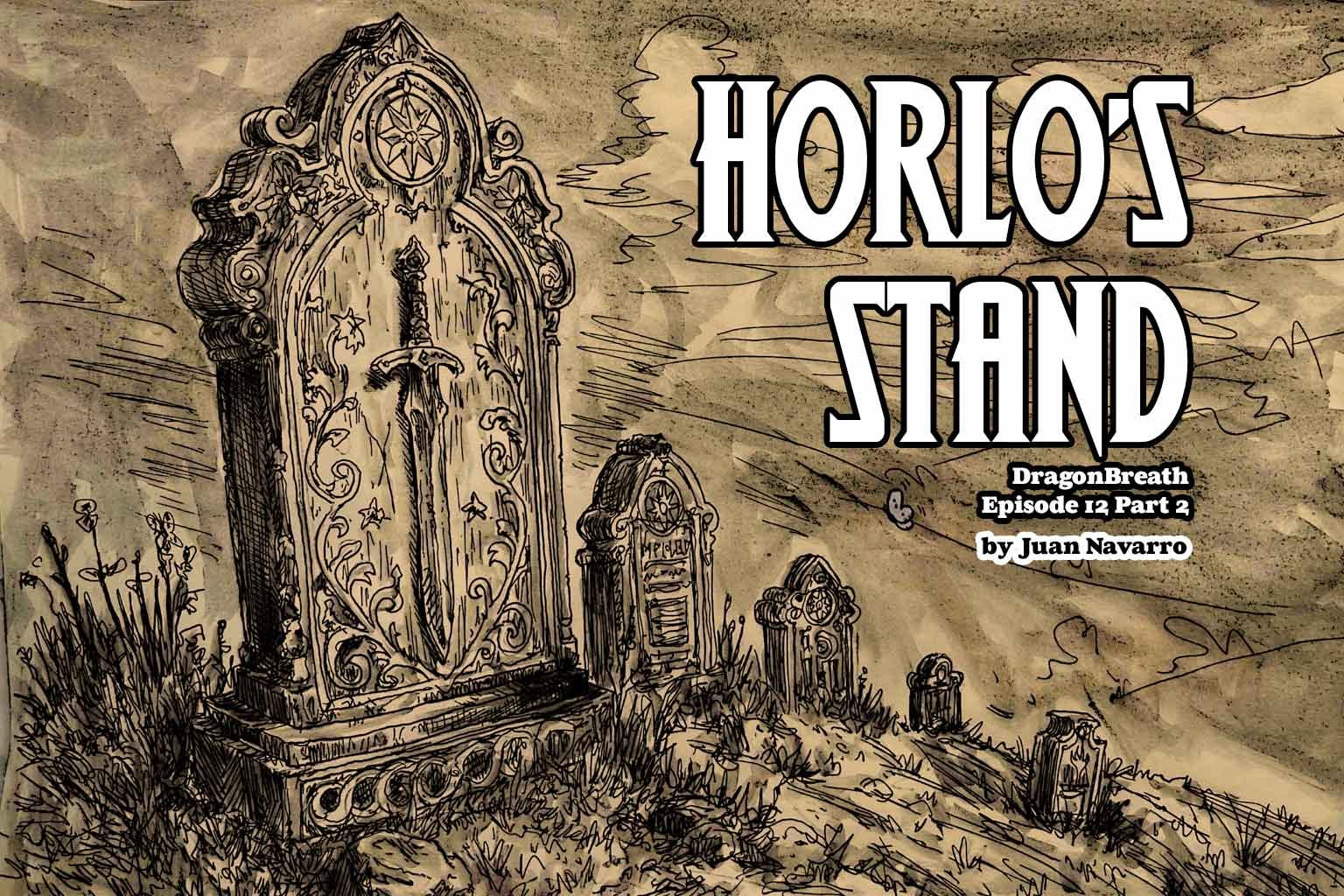
There stood the graves.
Horlo Guiliamet at the center, beneath a small stone sword.
Around him rested the others. Arkady. Margus. Thornfeld, who had only recently passed, and Barbaranna sometime before.
Guardians, even now.
Gaf removed his hat. After a quiet time reflecting on the stones, he turned to Telma.
“What next?” he asked quietly.
Telma laughed softly at that. Old age bent her nearly double now, but warmth still lingered in her eyes.
“What next?” she repeated. “You live.”
She looked down toward the bustling town below.
“Horlo never got to grow old. Never had children. Never got peace.” Her smile trembled slightly. “So the rest of us do it for him.”
Gaf wrote that down carefully.
In the end, the only gift the living can give the dead is to keep living, stubborn and loud, even when it hurts. Every harvest, every laugh in the sunlight, every child cursing Horlo’s name for chores, became a quiet offering to his memory. The town’s future grew from his courage like weeds through old stone, and in the warmth of survival, the old wounds began, slowly, to heal—not by forgetting what was lost, but by honoring the price paid every time someone dared to hope again.
And so they did.
WHEW! What a journey to make this happen! I hope you enjoyed this one-two-part piece. Sorry it took a bit, but I was stuck on my 4th draft of this second part, and it was in danger of being a three-parter with what I wanted to do! Again, these smaller stories are meant to provide history and background, with context for the world of Essiadarius, which I think I may do a podcast about to get into what I’m trying to do here.
It is insane fun doing this, as much as it’s also a pain in the ass. Some of it is just keeping the various plates one has spinning in place, while other times it’s all about them hitting the floor when you are writing, and sometimes where they land is where they land. I plan to make a zine of this story, and when I do, I think it will have a full rewrite then- not something that would change what happened, but give it some flow and more context to the citizens of Horlo’s Stand and also where it is. For those of you paying attention, there are already Easter eggs in this; if you’ve read the other shorts on Dragonbreath.
Let me know what you think! I’m working on the next short and have plans for a more adventurous 6-parter that may bring together many of the characters you’ve met, but I need to go back to the novel a bit. I have about 30000 words done with 25-27 chapters but will need to get into it hard this summer, so I hope to have this 3rd or so draft done by October to possibly put it out….January? I will see.
If you dig this and want to receive more, please subscribe! You can also get some original art and my comics, signed on the FOUNDERS level!