


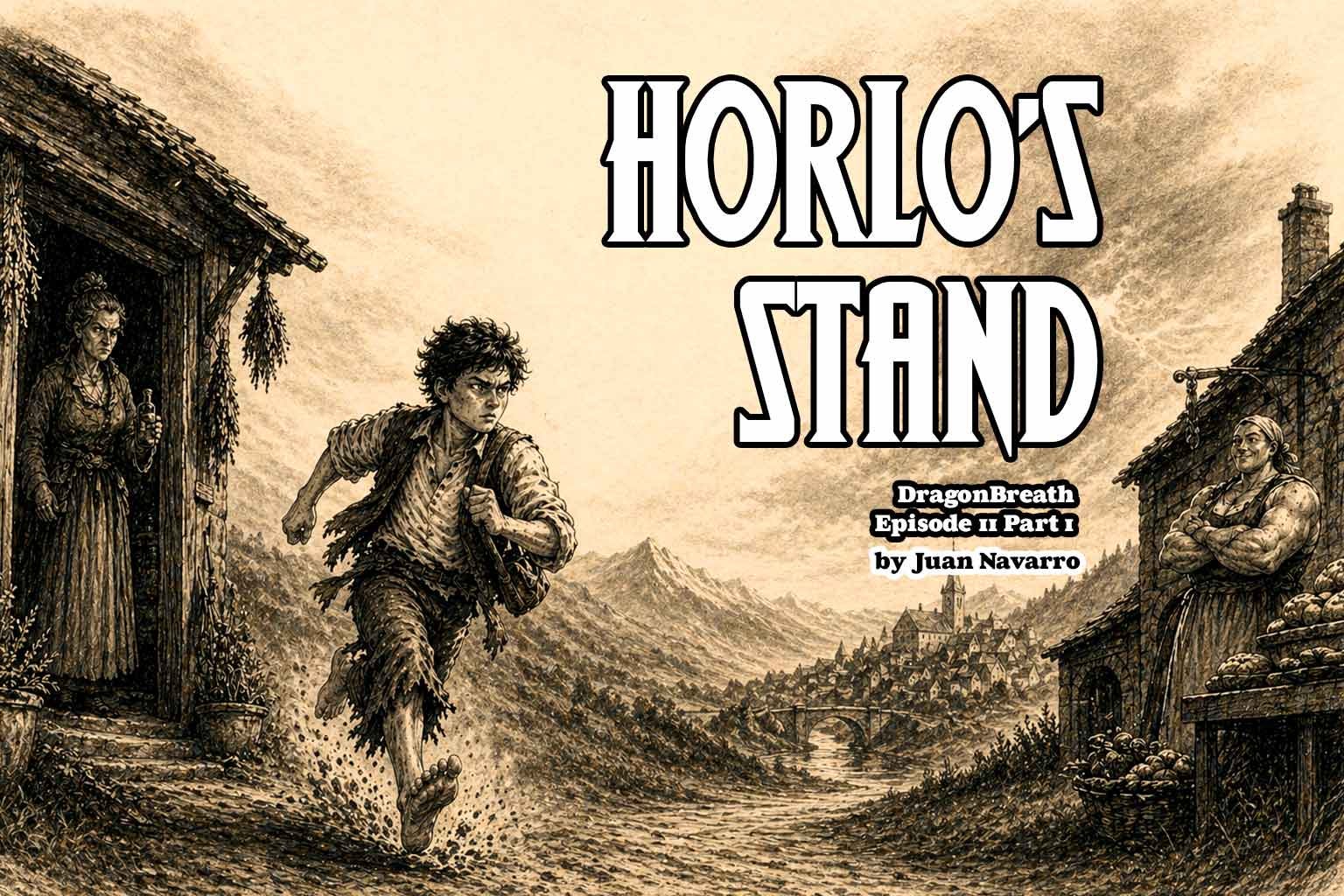
NOTE: This was the short I was being a stickler about, and I wanted to keep it small and not let it explode into some ridiculous saga when I just wanted to tell a story. So this is part 1 of 2, and I will be battling the 2nd soon, but it may take a bit before you see it. Either way, if you enjoy these shorts and want to see more, let me know!
Horlo’s feet seemed to barely touch the ground as he ran across the field up the road. It was summer, and morning dew was steaming off the grass of the field, and it was as soft as a pillow under him.
“Barefoot like a halfling!” his mother would scream at him as he left the house.
He couldn’t stand the constraint of shoes, especially in summer. He was not going to pass the time confined in boots for fun. He made his way to the front gate of their small farm. Without hesitation, he leaped into the air, his strong legs vaulting him over. He had done this so often that it came easily. He laughed as he kept going.
The village squatted ahead, small and stubborn, smoke curling from cookfires, doors yawning open to the day like mouths waiting for something interesting to happen. The place had no name.
Not officially.
People had tried, once or twice, to christen it with something grand. Then the crops needed tending, the weather turned, and the business of not dying took precedence. So it remained what it was—the place by the river, the settlement near the bend, or just home, if you were feeling sentimental.
Horlo hated that. He thought a real place should have a proper name—without one, it seemed incomplete, as if it didn’t matter enough to be remembered.
How could you have legends in a place with no name? Horlo wondered how anyone could spin a tale about a nameless home. Even ghosts needed an address.
Without a name, the whole place felt temporary to Horlo, as if one morning it might simply forget itself and vanish, leaving nothing but a patch of grass and a few confused chickens. Still, as he passed through, he called out greetings—mostly because his mother would tan his hide if he didn’t.
“Morning, Miss Ellow!” he called.
The cheese monger waved without looking up, elbow-deep in curds. “Tell your mother I need more of that bitterleaf oil!”
“You said that yesterday!”
“And I meant it then, too!”
Horlo laughed and kept moving.
He passed fishermen with smoked catch, farmers arguing over soil, as if it had insulted their ancestors, and a cobbler hunched at his bench, like a man solving the mystery of feet.
Thornfeld. New to town. Quiet.
Thornfeld looked up briefly as Horlo passed, their eyes meeting. Something sharp and measuring flickered and vanished.
“Morning,” Horlo said.
Thornfeld nodded once. “Try shoes one day.”
Horlo snorted. “Try running.”
A faint smirk appeared briefly on the man’s face.
The smell hit him before he even saw the bakery. Warm bread. Sweet glaze. Butter so rich it seemed to glow. Towering over it all was Barbaranna.
Horlo burst through the door like a storm with legs.
“JU!—” she started, turning, already mid-yell—
—and then her face cracked into something softer.
“—little rabbit!”
She pulled him into a crushing hug that smelled like flour and firewood and something older.
Horlo wheezed. “Spices—!”
“Ah!” She released him and snatched the bundle from his hands. “From your mother, yes? That woman grows things that shouldn’t exist.”
“She says that about your baking.”
“GUD. Means we unduh stanz each other.”
Barbaranna moved like a walking boulder—grounded and unstoppable. Her Karabekian accent wrapped around every word, almost strangling it for fun.
She turned, shouting at someone behind the counter. “KYORCHOO! NO, YOU DON’T NEED DAT MOOCH SALT UNLESS YOU PLAN TO KILL SOME-VUN!”
Horlo leaned on the counter, watching Barbaranna work. With her size and arms like tree trunks, you’d think she’d be better suited to chopping wood or wrestling oxen, but here she was, conjuring croissants so light they might float away if she didn’t glare at them. Her hands moved with a priest’s patience and a butcher’s certainty, folding dough into something that looked like it belonged in a fairy tale. Horlo watched, half in awe, half in envy, and wondered if he’d ever manage anything so delicate. People here seemed content with their nameless lives. He wondered if boredom ever killed anyone outright.
“You luk lake someone pissed in jor future,” Barbaranna said without looking at him.
Horlo shrugged. “Barbara Ann, do you ever feel like there’s more out there?”
“There iz,” she said flatly.
He blinked. “Then why are we here?”
Now she looked at him.
She truly looked at him.
“Yu tink dis iz no-ting?” she said, quieter now.
Horlo hesitated. “It’s just… quiet.”
Barbaranna leaned on the counter.
“Boy,” she said, voice dropping, “dare was a time dah ground screamed.”
He stilled.
“Dare are tings,” she continued, “dat didn’t care if yu are strong or clever or kind. Dey ate all three.”
She tapped the counter.
“Peace,” she said, “is not boring. It is rare.”
Horlo frowned. “We don’t even have a name.”
She snorted. “Then live long enough to see one.”
It might have gone on like that, the two of them circling around an argument neither was quite willing to finish, but the sound of approaching riders cut through the moment. It was not the slow, uneven rhythm of farmers returning from fields, nor the heavy wagons of traders. This was sharper, more deliberate, the kind of movement that suggested purpose.
The village noticed, though no one said so outright. People paused in their work. Conversations faltered. Heads turned, just slightly, as the riders came into view.
There were five of them. They carried themselves with the quiet certainty of people who had already survived things no one here would willingly imagine. It was not their weapons alone—though there were plenty, steel and iron worn to familiarity. It was also the way they occupied the road, as if it belonged to them for as long as they chose to stand there. They did not slow for the village, nor did they hurry. They simply arrived. In doing so, they made the morning feel smaller.
The man at the front wore a crooked cap, which might once have been respectable. Now it had given up the effort. Beneath it, his face bore the marks of a life spent thinking faster than most men could act. Over his left eye was etched a tattoo that curled in upon itself, like a thought that had gone too far. Those who knew such things might have recognized it for what it was—a sigil of study, of power carefully measured. To Horlo, it looked like trouble that had learned to sit still. The man’s gaze passed over the village, not with curiosity, but with quiet accounting. It was as though he were weighing its worth without intending to buy.
Behind him rode a figure cloaked so completely that even the sunlight seemed to hesitate before touching her. No face could be seen. No skin, no hint of expression. Still, there was something unmistakable in the way she held herself. She moved with an economy of motion, a stillness that did not read as rest but as readiness. The others rode as men do, shifting with the rhythm of their animals. She seemed to float just slightly above it, as though the act of riding were beneath her notice. It was not arrogance. It was something older than that. Horlo did not know the word for it, but he felt it all the same.
The dwarf came next, and Horlo stared. He had heard of dwarves—everyone had—but seeing and hearing are different. The pony beneath him was sturdy and unimpressed, an animal long accustomed to the weight of the world. The dwarf looked carved rather than born, shoulders wide, beard thick, presence so grounded the earth seemed to claim him. A heavy, plain mace rested across his lap, carried as fact, not threat. If he meant to use it, there would be no warning.
Next to the dwarf rode a man who might have been mistaken for a priest, though only by someone who ignored everything but his robes. He was tall—taller even than seemed proper. His height stood out beside the others, so he looked like a banner planted in uneven ground. Beneath those robes, he wore not humble cloth, but a patchwork of armor and scale. Plates of different make and memory were stitched into something clearly earned, not issued. The white of his outer garment had long since given up any claim to purity; it bore stains, soot, and the faint ghost of old blood that no washing would remove. Across the chest, an emblem had been painted—some mark of the Azure Moon or another quiet god. It had been smeared and reapplied so many times that it now looked less like devotion and more like persistence.
He carried no single weapon in a prideful display. Still, there were tools about him that suggested violence was not foreign to his trade. A mace hung at his side, shorter than the dwarf’s but no less capable of ending a man’s argument. Small charms and bone tokens clinked softly from his belt with every movement, each one likely tied to some prayer or ward. Some things were better left untested. Still, for all that, there was something about him that did not invite fear, but consideration. His face was open in a way the others’ were not, lined not by suspicion but by quiet acceptance of things as they are. His eyes moved over the village with a measured calm. He was not dismissive, not impressed, just attentive, as though already taking stock of what might be asked of him before anyone even thought to ask.
If the others looked like men who had come from danger, this one looked like a man who had walked through it, buried what needed burying, and continued on because stopping had never been an option.
The fifth rider—if he could be called that—was a man of long black hair and an expression that suggested he had never once in his life declined an opportunity to be noticed. He lingered just behind the others as they came to a stop, as though waiting for something, some invisible cue that only he could hear. And then, as if the world had finally caught up to his expectations, he moved.
He did not dismount so much as abandon the idea of riding altogether.
One moment he was in the saddle, the next he was not—falling, it seemed, until the fall became a turn, and the turn a roll, and the roll a smooth rise to his feet that ended with him standing perfectly balanced in the dust of the road. Before anyone could decide whether to be impressed or concerned, there were daggers in his hands. No one saw where they came from. They simply were, catching the light as they began to move, one to the next, a seamless pattern that suggested less skill than inevitability.
The village, which had thus far pretended not to stare, gave up the pretense.
A murmur spread, low and appreciative, the kind that gathers when something unfamiliar proves itself entertaining enough to forgive its strangeness.
The man bowed—deep, extravagant, entirely unnecessary—and when he rose, his smile was already in place, bright and dangerous in equal measure.
“Good people,” he called, his voice carrying easily without strain, “you find yourselves blessed this morning, though I can see you are attempting to hide your gratitude out of modesty.”
A few laughed, uncertainly. Others folded their arms, prepared to be unimpressed.
He paid them no mind.
“We are travelers,” he continued, “seekers of fortune, collectors of stories, and, on occasion, providers of solutions to problems that prefer not to be solved. We have walked where maps grow tired, we have seen things that would make your goats reconsider their life choices, and—most importantly—we have survived long enough to speak about it in ways that are only slightly exaggerated.”
At this, he sent one of the daggers spinning higher than the rest, catching it behind his back without looking, as if the act required no more thought than breathing.
“The Blades of Borel,” he declared, spreading his arms just enough to include the others without quite asking their permission. “At your temporary service, provided your needs align with our interests and your coin aligns with our expectations.”
The mage in the crooked cap snorted softly and shook his head, reaching up to adjust the offending article as though it had somehow participated in the speech.
“Must you always begin like that?” he asked.
“Always?” the dagger-man—Azzer—repeated, offended. “My dear Richard, I have refined this over the years. There was a time I opened with fire.”
“You still do,” the mage replied dryly. “It’s simply verbal now.”
A few more in the crowd laughed, more comfortably this time. The tension eased, if only a fraction.
Azzer inclined his head in acknowledgment, as though accepting applause that had not quite been offered. “A fair point. Growth is important. It shows maturity.”
“It shows survival,” the dwarf muttered.
Azzer turned, hand to heart. “And what is maturity if not survival with better timing?”
The veiled figure said nothing, though her head tilted slightly, and Horlo had the distinct impression she was watching the crowd in a way that had nothing to do with amusement.
Azzer, satisfied that he had given the village something to remember, clapped his hands once, the daggers vanishing as abruptly as they had appeared.
“Now then,” he said, as though concluding a performance rather than beginning an arrival, “unless anyone has an immediate need for heroics, we find ourselves in desperate want of ale, bread, and a place to sit where no one attempts to kill us for at least the length of a meal.”
“Ambitious,” the priest murmured.
“Reasonable,” Azzer corrected.
The mage gave a small, resigned gesture toward the inn. “Before you escalate this into a festival.”
“With pleasure,” Azzer said.
And just like that, the moment folded in on itself. The performance ended. The five of them turned as one—not sharply, not with command, but with the quiet agreement of people accustomed to moving together—and made their way toward Orkell’s Inn as though it had always been their destination, and the rest merely a preamble.
The crowd parted without being asked.
Horlo stood where he was, heart hammering, the echo of that brief spectacle still ringing in his chest. He had seen traveling merchants, once a caravan from Borel itself, even a pair of soldiers who had claimed to have fought in some distant campaign—but this was something else entirely.
These were not visitors. These were stories that had decided, for reasons of their own, to walk.
Horlo knew well enough that he was not meant to be inside the tavern. Children were tolerated in the daylight hours, when errands were to be run and bread to be carried, but once the tables filled and the mugs began to empty at a quicker pace, the place belonged to voices that had seen too much and wished to forget it for a while. His mother had said as much, more than once, and in a tone that suggested it was not a rule to be tested.
That did not stop him.
The front door was watched, as it always was, not by guards but by the simple attention of those who sat near it and took notice of who came and went. Horlo avoided it entirely, slipping instead along the side of the building where the kitchen door stood propped open to let the heat escape. He had carried baskets through that doorway often enough that no one would think to question him now, especially if he moved with purpose.
Inside, the kitchen was a chaos of motion—steam rising from pots, knives striking boards in quick rhythm, voices calling out orders that were answered before they had fully left the speaker’s mouth. Horlo passed through it like a shadow that knew where not to step, ducking beneath a swinging ladle and sidestepping a woman who turned with a tray balanced high. No one stopped him. No one asked. He was part of the place, and that was enough.
The back of the tavern opened before him, dimmer than the kitchen, cooler, and thick with the smell of ale and old wood. The light from the front windows did not reach this far, and the lanterns that hung from the beams cast a low, uneven glow that left more hidden than revealed. It suited Horlo just fine.
He kept to the edges, moving behind chairs and along the wall, his eyes fixed on the table where the five had gathered. They had chosen a place that allowed them to see the room without being the center of it, though Azzer, for all his earlier theatrics, seemed incapable of not drawing attention in smaller ways. He leaned back in his chair with one leg stretched out, speaking with his hands as much as his voice, while the others listened in the manner of people who had heard such things before and found them no less amusing for it.
Horlo dropped low near the end of the bench, close enough now to hear them clearly.
“…and I tell you,” Azzer was saying, holding his hands apart as though framing the size of something too large to be contained, “the thing had teeth the length of my forearm, and not the courtesy to keep them to itself. It comes at me out of the dark, all hunger and bad intention, and I think to myself—Azzer, this is the sort of situation that requires a measured response.”
The dwarf grunted. “You ran.”
“I repositioned,” Azzer corrected, without missing a beat. “There is a difference. Running suggests panic. I was calm. Focused. Deeply invested in not being eaten.”
The priest’s mouth twitched. “You climbed a tree.”
“A strategic elevation,” Azzer said. “You cannot argue with height. Height is the friend of the thoughtful man.”
“It broke the tree,” the mage added, mildly.
“Well, yes,” Azzer admitted. “But at that point, we had established a relationship.”
Horlo leaned forward, completely taken in. He could see it all as Azzer spoke—the dark, the creature, the desperate scramble for safety—and though some part of him suspected the truth had been stretched in the telling, he did not care. The story’s shape was enough.
“…so there I am,” Azzer continued, “hanging from what remains of a branch, reconsidering several of my life choices, when our good Turg here decides that the creature has had enough fun for one evening.”
The dwarf did not look up from his drink. “It was making a noise.”
“A terrible noise,” Azzer agreed. “Offensive, really. And so, with the delicacy for which he is known, he introduces it to the ground in a manner that leaves a lasting impression.”
“I hit it,” Turg said.
“Yes,” Azzer said, with satisfaction. “You did.”
Horlo let out a breath he had not realized he was holding, his mind racing to keep up with the images being offered. He shifted his weight slightly, trying to get a better view of the veiled woman, who had thus far said little. There was something about her stillness that drew him more than Azzer’s words, a sense that whatever she was, she required no embellishment.
As if sensing his attention, she turned her head.
For a moment, Horlo saw beneath the veil—not clearly, not enough to make out features, but enough to know what he was looking at. The shape of her face, the line of her jaw, the faint suggestion of ears that did not sit as a human’s would.
An elf.
He had never seen one before.
The world shifted slightly around that realization, as though something he had only ever imagined had decided to exist without asking his permission.
He leaned forward, too far this time, his hand slipping against the wood beneath him.
It was a small sound.
It was enough.
Azzer’s hand moved without looking, reaching down and closing around Horlo’s collar with an ease that suggested he had been aware of the boy’s presence for some time. He drew him up into the light as one might retrieve something dropped, setting him on his feet beside the table with a practiced motion.
“Well now,” Azzer said, finally looking at him properly. “Either the tavern has begun to grow children under the tables, or we have acquired ourselves a listener.”
Horlo flushed, his mouth opening and closing as he searched for something to say that did not sound entirely foolish.
“I—was just—”
“Listening,” Azzer supplied, nodding. “An excellent habit. Underrated, in my opinion.”
The others regarded him with a curiosity that was neither unkind nor dismissive. The priest inclined his head slightly, as though greeting him as an equal rather than an interruption. The mage’s eyes sharpened for a moment, taking measure, before softening again. Even the dwarf gave him a brief glance that held no annoyance, only acknowledgment.
“Horlo,” he managed at last, remembering himself enough to speak.
“Horlo,” Azzer repeated, as though tasting the name. “A strong name. Quick. Useful in a shout.”
He nudged a chair toward him with his foot. “Sit, Horlo. If you’re going to eavesdrop, you might as well do it comfortably.”
Horlo hesitated only a moment before taking the seat.
Up close, they were no less impressive, but something in their manner had changed. The edge that had marked them as dangerous had softened, not gone, but set aside, as though they recognized in him something that did not need guarding against.
“A breath of fresh air,” the priest murmured, almost to himself.
“Or trouble,” the mage replied quietly.
Azzer grinned. “Those are often the same thing.”
He leaned forward, resting his arms on the table, his attention fully on Horlo now.
“So then,” he said, “since you’ve already heard the part where I was nearly eaten, it seems only fair that you hear the part where I was not.”
And with that, he began again, the story growing in his hands, while the others watched on—not correcting, not interrupting, but allowing it, as though the telling itself were part of what they carried with them.
Azzer leaned back in his chair as though he had just been handed a stage rather than a table, one arm slung over the backrest, the other gesturing broadly toward his companions. His grin widened, not unkindly, but with the unmistakable delight of a man who had found an audience that did not yet know enough to be skeptical.
“Well then, Horlo,” he said, tapping the table once as if to call the room to order, “since you’ve risked life, limb, and likely your mother’s temper to join us, it would be a poor showing on my part not to make proper introductions. We are, after all, professionals. Mostly.”
The mage sighed faintly into his drink.
Azzer ignored him.
He gestured first to the veiled woman, though now, as if in recognition of the moment, she had drawn the cloth back just enough to reveal her face. It was not done dramatically, nor with any effort to impress, but the effect was immediate all the same.
“Deoramas Thornseer,” Azzer said, with a slight flourish that carried more respect than his tone suggested. “Wanderer of the Fey Court, blade in service to powers older than most maps, and a woman who has forgotten more paths than you or I will ever learn.”
Deoramas regarded Horlo quietly for a moment before leaning forward. There was no hesitation in the movement, no sense that she was doing something unusual or intimate. It was simply what she chose to do. Her hand rose and brushed lightly against his cheek.
“I see you, boy,” she said.
The words were soft, but they carried weight. Horlo felt it immediately—not fear, not quite awe, but something that settled somewhere deeper. Her touch was light as a feather, but it held a strange charge, like the moment before lightning strikes, when the air thickens, and the world seems to pause in anticipation. At the same time, there was a calm in it, a quiet warmth that reminded him of long summer evenings when nothing moved but the wind through the fields.
He blinked, unsure what to say, and found that nothing seemed quite right.
Azzer, for once, did not interrupt.
He moved on with a small nod, turning to the dwarf.
“And this,” he said, “is Turg Hammerel. Miner, warrior, breaker of things that prefer not to be broken. He’s out to find himself a piece of the world that hasn’t yet learned to resist him, so that he might plant a cairn and call it home.”
Turg looked at Horlo, really looked at him, in a way that felt less like judgment and more like assessment. He gave a single nod, slow and deliberate.
Horlo stared.
Up close, the dwarf did not seem entirely real. He was too solid, too present, as though someone had taken a chunk of mountain and taught it to walk. The muscles beneath his skin did not shift so much as settle, and there was a heat to him that Horlo could feel even from where he sat, like standing too close to a forge. It was not uncomfortable, but it demanded attention.
Horlo had never imagined a person could feel like that.
“Aye,” Turg said, after a moment, as though that explained everything.
Azzer spread his hands, pleased. “You see? A man of few words. All of them are important.”
The mage snorted again, quieter this time.
Azzer pointed at him without looking. “Which brings us to this collection of poorly contained thoughts.”
Richard HeirStein did not look offended. If anything, he seemed faintly amused, though it was difficult to tell where his attention truly rested. His eyes moved constantly, taking in the room in pieces, assembling something only he could see.
“Richard HeirStein,” Azzer continued, “of the Borellian Court. Third Plateau of the School of Magic, which I am told is very impressive if you enjoy things like structure and restraint. Explorer, thinker, and the only man I trust to explain why something has gone wrong after it has already done so.”
Richard inclined his head slightly toward Horlo. “Do not let him mislead you,” he said, his voice measured and even. “Most things go wrong because someone insists on testing whether they might.”
Azzer placed a hand over his heart. “Curiosity is the engine of progress.”
“Curiosity is the engine of disaster,” Richard replied.
Horlo found himself staring again, though for a different reason this time. There was something about the man that made him seem… sharp. Not in a dangerous way like a blade, but in the way of a thought that cuts cleanly through confusion. He looked like someone who knew things, and more than that, knew how to use them.
Horlo wondered, briefly, what it might be like to understand the world the way that man seemed to.
Azzer, sensing the moment had gone on long enough without his involvement, clapped his hands softly and turned to the last of them.
“And finally,” he said, with a touch less theatrics but no less care, “we have Regius Hammond. Road priest of the Azure Moon, healer of wounds both visible and otherwise, and a man who insists on writing everything down, no matter how much better it might sound if left to memory.”
Regius smiled at that, a calm, untroubled expression that seemed to belong to someone who had already made peace with a great many things.
“It is not that I insist,” he said gently. “It is that forgetting has a way of repeating what should be remembered.”
He looked at Horlo then, properly, and there was no weight in it like there had been with Deoramas, no sharpness like Richard, no grounded force like Turg. It was simply attention—clear, present, and unhurried.
“Are you well, Horlo?” he asked.
The question caught the boy off guard. He nodded quickly. “Yes, sir.”
“Good,” Regius said. “It is a fine thing, being well.”
Azzer leaned back again, satisfied, as though he had just concluded a performance worthy of applause.
“And there you have it,” he said. “A gathering of questionable decisions, held together by circumstance and mutual tolerance. And now—”
He leaned forward, his grin returning in full.
“—We are yours to impress, Horlo of the nameless village. Tell me, what great deeds have you accomplished this morning?”
The moment did not so much end as it was taken.
The tavern door opened without force, yet the air shifted as if something had entered that did not care to ask permission. Conversation did not stop outright, but it faltered in places, the way a fire does when a draft moves through it. A few heads turned. A few more followed.
Marna KitFeather stood in the doorway.
She did not look like a woman who had come to drag her son home. She wore no anger on her face at first glance, no raised voice, no immediate demand. She was simply there, framed by the last light of the evening, her hair pulled back, her hands empty, her eyes moving once across the room before settling—unerringly—on Horlo.
Azzer, who had been mid-sentence, stopped.
It was not obvious. To anyone else, it might have looked like a pause for effect. But those at the table felt it—the subtle tightening, the shift of attention. The man who had made a performance of everything since his arrival now chose, quite deliberately, to say nothing at all.
“Well,” he murmured under his breath, just enough for the table to hear, “that looks like consequence given shape.”
Horlo turned.
“...oh.”
There was no escape in that moment, not even the illusion of one. His mother did not call his name. She did not need to. She simply stepped into the room and began walking toward him, her path opening as people moved aside without quite knowing why.
She reached him, and only then did her hand come up—not to strike, not to grab in anger, but to take him by the ear with a firm, practiced grip that brooked no argument.
“Come,” she said.
It was not loud.
It did not need to be.
Horlo stood, cheeks already burning, acutely aware of the eyes on him—the adventurers, the patrons, the entire room that had, only moments before, seemed so large and full of possibility. Now it felt very small.
“Ma, I was just—”
“I can see what you were just,” Marna said, turning him toward the door with a steady pressure. “And I can see how long you have been just doing it.”
Azzer raised a hand slightly, as though considering whether to intervene, or at least to soften the moment with a word. Whatever thought crossed his mind died quickly. He met Marna’s gaze for the briefest of instants—and then looked away.
“Well,” he said, lightly, though the edge had dulled, “we do apologize for the theft of your son, madam. He came willingly, I assure you. Very determined about it.”
Marna paused.
She did not release Horlo’s ear.
She turned her head just enough to look at Azzer, and for a moment the room seemed to hold its breath.
“You didn’t take him,” she said. “He went where he shouldn’t.”
There was no accusation in it. No heat. That was what made it worse.
Azzer gave a small, almost respectful nod. “A habit worth having, in the right circumstances.”
“In the wrong ones,” Marna replied, “it gets you killed.”
Richard shifted slightly in his seat, watching now with more interest than before. Turg’s hand rested near his mug, not tense, but ready in a way that spoke of old instincts. Deoramas said nothing, though her eyes followed Marna with a focus that suggested recognition of something not yet spoken.
Regius inclined his head, quiet.
Marna turned back to her son.
“Out,” she said.
Horlo went.
The walk home felt longer than it ever had.
Marna did not speak at first, and that silence was worse than anything she might have said. Horlo kept pace beside her, glancing up once or twice, hoping for some sign that this would pass quickly, that it was the sort of scolding that ended in a sigh and a shake of the head.
It did not.
When she did speak, it came without raising her voice.
“You think they are something to admire,” she said.
Horlo swallowed. “They’re—”
“They’re what?” she asked, not turning to him. “Heroes? Legends? Something out of the stories you like to fill your head with when you should be listening?”
“They’ve seen things,” Horlo said, more stubbornly than he intended. “Done things. They’ve been out there.”
“And come back,” Marna said.
“Yes,” Horlo replied, as if that proved something.
Marna stopped.
She turned then, and whatever Horlo had been prepared to say next vanished.
“Some of them come back,” she said. “Some come back in pieces. Some come back in ways that never leave them. And most don’t come back at all.”
Horlo frowned. “But they—”
“They chase things that don’t belong to them,” she cut in. “Gold, glory, whatever word you want to use for it. They tell themselves it means something. That makes them more than what they are.”
“They are more,” Horlo insisted, though the certainty wavered under her gaze.
Marna’s expression hardened, not in anger, but in something deeper.
“They are people who choose to live in danger,” she said. “And in doing so, they drag that danger with them. Into places that did not ask for it. Onto people who do not deserve it.”
“That’s not—” Horlo began.
“That is exactly what it is,” she said, quietly now. “You think it is all stories and laughter and clever words. You think it is something you can step into and step out of again.”
He hesitated.
“Yes,” he said.
Marna let out a breath that was almost a laugh, though there was no humor in it.
“You don’t understand,” she said.
“No,” Horlo admitted, frustrated now. “I don’t. Why is it so bad to want more than this? To see something beyond the same road every day?”
Marna looked at him for a long moment.
Then she turned and began walking again.
“Because ‘more’ has a cost,” she said. “And you don’t get to choose how it’s paid.”
The rest of the evening passed quietly.
Dinner was eaten with little conversation. Horlo answered when spoken to, kept his eyes down when he could, and replayed the moments in the tavern over and over in his mind—the stories, the laughter, the way they had looked at him not as a child, but as something worth speaking to.
By the time he went to bed, the house had settled into its usual calm. The sounds of the village had faded, replaced by the small, familiar noises of night.
He lay there for a while, staring at the ceiling, listening.
Something felt… unfinished.
After a time, he rose.
The light from his mother’s room was still on.
He hesitated in the doorway, just long enough to tell himself he could still go back to bed, still pretend he had not noticed.
Then he stepped inside.
Marna sat on the edge of her bed, her back to him, something held carefully in her hands. Her shoulders were still, but there was a tension in them that had not been there earlier.
“Ma?” he said.
She did not startle.
She did not hide what she held.
She simply took a breath, steadying herself, and said, “Come here.”
Horlo stepped closer.
Only then did he see the glint of metal in her hands.
A blade.
Not new.
Not polished.
Something older.
She turned slightly, enough for him to see her face.
There was no anger there now.
Only something else.
Something he had not seen before.
“Sit,” she said.
And this time, Horlo did not argue.
Marna turned the dagger over in her hands before she spoke, as though the words she meant to say might be found somewhere along its edge if she looked long enough. The light from the lamp caught along the worn metal in uneven glints, revealing not polish, but use—small nicks, faint discolorations, the quiet history of something that had done its work without ceremony.
“When the Horrors fell,” she said at last, her voice steady, “they didn’t leave the world whole. They left it open. Empty in places. Dangerous in others. Some say the Horrors were never meant for our world—a plague of shadows and hunger, wearing flesh and smoke, born in the dark beneath the world’s skin. No one who saw their true faces ever spoke of it twice. There were stretches of land no one had set foot on for a thousand years, not because no one wanted to, but because nothing had survived long enough to try.”
Horlo listened without interrupting, his eyes moving between her face and the blade.
“The kingdoms sent people out,” she continued. “Soldiers, settlers, anyone willing to take a claim and hold it. That’s how places like this begin. Not with names, not with banners. Just people deciding not to leave.”
She paused, then added, quieter, “Your father was one of them.”
The words settled between them.
“He grew up in it,” she said. “Among people who believed the world could be taken back piece by piece. And among them were others—those who didn’t stop at the edge of the known. They went further. Into places that had no maps. Into ruins that had no names left to remember them.”
Horlo leaned forward slightly. “Adventurers.”
Marna gave the faintest nod. “If you want to call them that.”
She shifted the dagger in her hands.
The Violet Isles had their own,” she said. “Navigators. Led by a man named Savant. Not sailors—though they could be—but something more. They moved through the world the way others moved through a room. Finding things. Controlling things. Ending things, when they had to. There was an old saying in the Isles, always whispered twice for luck: ‘Where Savant points, the sea listens. Where a Navigator treads, lost paths open.’ To some, it was a warning; to others, a promise.
Her eyes flicked to Horlo. “Others followed in their shadow. Smaller bands. Clans. Leagues. Some went out for land. Some for gold. Some for the simple need to see what lay beyond the next hill.”
“And they came back?” Horlo asked.
“Some,” she said. “Some came back rich. Some came back broken. And most didn’t come back at all.”
She let that sit before continuing.
“That’s where I met him. Dyrk.” Her voice softened at the name. “Your father.”
Horlo felt something shift in his chest.
“He was…” she hesitated, then allowed herself a small breath of something like memory. “He was alive in a way that made other people seem half-finished. Always looking ahead. Always certain there was something better just beyond reach.”
She looked at Horlo, and whatever warmth had touched her expression faded into something harder.
“He believed that standing still was the same as dying,” she said.
Horlo said nothing.
“And that belief is what killed him.”
There was no anger in it. No drama. Just truth.
“It wasn’t some great beast,” she went on. “Not some story worth telling twice. It was a choice. One more step forward when there was no need. One more risk because the last one hadn’t ended him.”
She held the dagger out slightly.
“This is what came back,” she said. “What was left?”
Horlo reached out and took it, carefully. It felt heavier than it looked.
“It was a sword,” she said. “Broke in a fight. He used what remained to get himself out of it. Later, he had it cut down, reforged into this. Said one day he’d give it to his son.”
She watched him hold it.
“I didn’t want to give it to you,” she admitted. “Because he thought that life—the running, the chasing, the never stopping—was the only life worth having.”
Her voice lowered.
“I saw what it does to people.”
Horlo looked up at her, unsure what to say. His fingers tightened slightly around the hilt.
“I just…” he started, then stopped, searching for the words. “I just think it’s exciting. That’s all. I’m not going anywhere.”
The lie came easily.
Too easily.
Marna stared at him for a long moment, then sighed—not in frustration, but in something softer, more tired.
“Oh boy,” she said, reaching forward and cupping his face in both hands. “You are as bad a liar as yer father.”
And then, as if to undo the weight of everything she had just said, she kissed him—once, twice, then again, quick and warm and familiar, until he laughed despite himself and tried to pull away.
She let him go, though her hands lingered at his shoulders.
She looked at the dagger once more before gently taking it back from him, holding it between them.
“I don’t want this to decide for you,” she said. “Or for you to think it has to.”
She placed it in his hands again, more deliberately this time.
“It’s a choice,” she said. “Same as it was for him. Same as it is for everyone. This life, that life—none of it is given. It’s taken. And paid for.”
Her gaze softened, just a little.
“And you’ll make your own choice. Just like the rest of us did. Even here. Even in a place that doesn’t have a name yet.”
Horlo stood, uncertain for a moment, then stepped forward and wrapped his arms around her. She held him tightly, one hand still resting lightly against the back of his head.
“I’m not going anywhere,” he said again, quieter this time.
She didn’t answer that.
She just held him.
It was a small, quiet moment, the kind that did not ask to be remembered but would be all the same.
Later, in his bed, the house settled into silence around him. Horlo lay awake staring into the dark, the shape of the dagger still lingering in his hands as if he had never let it go.
He could still hear Azzer’s voice.
Still see the way they had sat, the way they had spoken, the way the world seemed larger around them.
He turned onto his side, closing his eyes.
And though he had promised—
Though he meant it, in that moment—
He knew, somewhere deep and certain, that when the time came, he would choose the life that blade belonged to.
The next morning came too quickly for Horlo’s liking, and not quickly enough to matter.
He rose with the same restless energy that had followed him to sleep, the shape of the dagger and the sound of Azzer’s voice still lingering in his thoughts. If there had been any doubt in him that the day before had been something more than a passing curiosity, it was gone now. He dressed in a hurry, took up his satchel, and set off toward town with more purpose than his errands required.
They were gone.
Not in the dramatic sense Horlo might have imagined, no tracks carved deep into the road or whispers of departure hanging in the air. They had simply left, as quietly as they had come. Orkell’s Inn was already back to its usual rhythm, the tables occupied by the same men, the same complaints, the same slow turning of a day that asked nothing new of anyone.
Horlo stood for a moment outside the inn, looking at the door as though it might open again and produce them whole and laughing, ready to pick up where they had left off. It did not.
“Early risers,” someone muttered nearby. “Or running from something.”
“Or to it,” another replied.
There was talk, of course. There was always talk. It came in pieces, passed from one person to the next, each adding a little more certainty than the last. A man had come in the night, it was said—a stranger, cloaked and quiet, who had spoken only with the mage. They had not stayed long after that. South, someone said. Toward the hills before Algernia, where the land grew uneven, and the forests pressed too close together, where goblins and worse things were known to linger.
“Good riddance,” one of the older farmers said, spitting into the dust as though to seal the opinion. “Nothing good follows folk like that.”
Others said nothing, but their silence was not agreement. Horlo saw it in the way they watched the road, just a moment longer than necessary, in the way their hands stilled when the subject came up, as though remembering something they had not meant to.
Barbaranna said nothing at all, though Horlo caught her once standing in the doorway of the bakery, her arms crossed, her gaze turned southward. When she noticed him watching, she snapped back to her work with twice the force, shouting at a boy for burning a tray that had not yet had time to burn.
Life, as it tended to do, continued.
Horlo made his rounds.
There were herbs to be delivered, oils to be measured out, and powders to be exchanged for coin or favor. His mother’s work did not slow simply because something interesting had passed through the village. If anything, it seemed to increase. People came with small ailments, with requests for tonics, with questions they did not know how to ask directly. Marna answered them all with the same quiet patience, measuring, mixing, and instructing.
Horlo became her feet, as he often was. He carried satchels filled with carefully wrapped bundles from one end of the village to the other and beyond, along the river path and out to the scattered farms that marked the edges of their world. He knew the roads by heart, the turns and dips and stones that might catch a careless step. He moved quickly, efficiently, the work of it settling into his body like a rhythm he had long since learned.
Not that the work had changed. He had. Something inside him had shifted, like a stone in a riverbed, and now every step felt different.
Not because the work had changed, but because he had.
Every road now led somewhere else, at least in his mind. Every path out of the village stretched further than it had the day before. The hills on the horizon weren’t an end anymore. They were a beginning he could almost taste, but never quite see.
A week passed.
Then another.
The talk of the Blades of Borel faded, as all things do. New concerns took their place. The weather turned slightly, the mornings carrying a sharper edge that spoke of the coming cold. Preparations began in earnest—wood gathered and stacked, roofs checked, stores counted and recounted. The river trade increased as merchants passed through, eager to move goods before the water grew less forgiving.
Horlo met people he had not seen before, though they spoke as if they had always been there.
A trader from Oceanforge with rings on every finger and a voice that never quite settled on one tone or another. He spoke of the city as though it were a living thing, all smoke and iron and noise, a place where a man could lose himself entirely if he was not careful. Horlo listened, wide-eyed, imagining streets that never ended and crowds that did not thin.
A pair of travelers from Borel who argued constantly, not in anger, but in a way that suggested neither would allow the other the last word. They spoke of ships and tides and the way the sea could change its mind without warning. Horlo carried their purchases to the edge of the village and lingered longer than necessary, hoping for more.
And once, a Karabekian river sailor came through, broad-shouldered and loud, his laugh carrying across the square before he had even dismounted. He found Barbaranna quickly enough, and the two fell into their shared tongue with a speed that left Horlo entirely behind. Their words rose and fell in sharp, musical bursts, punctuated by laughter and the occasional shove. They traded stories as easily as insults, each one trying to outdo the other until both were breathless from it.
Horlo stood nearby, catching none of it and all of it at once.
It was all great.
It was all the same.
The village trudged on, steady as a mule, each day stacking itself atop the last without asking for anything new. There was comfort in that, Horlo supposed—a quiet promise that tomorrow wouldn’t surprise you in ways you couldn’t survive.
But now, beneath that comfort, something else had taken root.
Restlessness.
It showed itself in small ways at first. A moment’s pause at the edge of the road before turning back. A glance held too long toward the hills. A question was asked and then withdrawn before it could be answered.
At night, he found himself listening—not to the sounds of the house, which he knew well, but to the spaces between them. To the possibility that something might break the pattern, might return, might call him back to that table where the world had seemed larger and more dangerous and more alive.
Nothing did.
The days passed.
The work continued.
And the memory of the Blades of Borel settled into him not as something that had happened, but as something that had begun.
By the time the month had turned, the village had nearly forgotten them.
Horlo had not.
He carried them with him—in the rhythm of his steps, in the way he watched the road, in the quiet certainty that the world beyond the hills was not just real, but waiting.
And though he could not have said when or how—
he knew, with a clarity that had nothing to do with reason—
that whatever had taken them south would not be finished with them.
Not yet.
It was a Sunday morning, the sort that seemed made to convince a person the world had settled into something gentle and lasting. The light came in soft and steady, the air carrying just enough warmth to promise a kind day without pressing it too far. There was no rush to anything. No urgency in the village. Even the river seemed to move with a quieter patience, as though it, too, had decided to rest.
Marna allowed herself such mornings when she could. Not often, and never without reason, but this time she had one.
“Come,” she said to Horlo, tying her hair back with a strip of cloth as she spoke. “We’ll take a break from your running about. Mrs. Orkell made tantoberry pie, and if we don’t get there early, there won’t be any worth eating.”
Horlo did not argue. He knew better than to question a gift when it came so plainly. They walked together into town, not hurried, not burdened by errands, just two people moving through a place they knew well enough not to think about it.
The tavern, in daylight, was a different creature entirely. The shadows that gathered there at night had retreated to their corners, and the room felt wider for it. Windows stood open, letting in the breeze and the sound of the village beyond—voices, carts, the low murmur of a place content with itself. A handful of patrons sat scattered at the tables, speaking in easy tones, mugs held without urgency.
Mrs. Orkell herself stood behind the counter, already in the middle of telling a story that had grown more elaborate with each retelling, her hands moving as much as her voice. Barbaranna sat nearby, not working for once, though she still looked as though she might begin at any moment out of habit alone.
“Ah,” Orkell said when she saw them. “You’ve come at the right time. Fresh out of the oven.”
She cut the pie with care, as if it were more valuable than most things, and set two generous slices before them. The smell alone was enough to quiet whatever thoughts Horlo had carried in with him. For a time, it was just that—warm pie, his mother across from him, the simple pleasure of being somewhere without needing to be anywhere else.
Marna even smiled.
It was small, but it was there.
Horlo was halfway through his second bite when the scream came.
It cut through the room cleanly, sharp and wrong, tearing the calm apart in a way that could not be mistaken for anything else. Every head turned at once. For a heartbeat, no one moved.
Then everyone did.
Chairs scraped. Mugs were left where they stood. The room emptied in a rush toward the door, voices rising, questions forming before anyone had answers to give.
Horlo was on his feet before he knew he had moved, following the others out into the light.
The horse stood in the road, sides heaving, foam thick at its mouth, its eyes wide with something that had not yet left it. It had come hard and fast and had not known how to stop until it could not go any further.
Across its back—slumped, half-fallen—was a man.
At first, Horlo did not recognize him. There was too much blood, too much of him hidden beneath it. His clothes were torn, dark with wetness, his body hanging at an angle that suggested it had forgotten how to hold itself together.
Someone stepped closer, then stopped.
“Gods,” a voice said.
Another turned away.
Horlo did not move.
He knew.
Before the face was seen, before the name was spoken, something in him recognized the shape of it.
Azzer.
What had been lively, laughing, impossible Azzer was now something else entirely—broken across the saddle, his skin pale beneath the smear of blood, his breath shallow enough that it might have been imagined.
The village reacted as villages do.
Some shouted questions into the air as though answers might fall from it. Some stood frozen, unwilling to come closer. Others stepped back, instinct driving them away from what they did not understand.
Horlo stood where he was, his mouth open, the taste of pie suddenly gone to nothing.
And then—
movement.
Not panic.
Not confusion.
Something else.
Marna was already there.
He had not seen her move, only that she was no longer beside him. She reached the horse at the same time as Barbaranna, who had come out of the tavern with a speed that belied her size, her voice already cutting through the noise.
“Hold him,” Barbaranna barked, and someone—no one Horlo could name—did.
Thornfeld appeared as if he had always been standing nearby, though Horlo could not remember seeing him before that moment. He stepped in without a word, his hands already at work, pushing aside torn cloth, examining wounds with a precision that felt practiced.
“Arrows,” Barbaranna said.
“Goblin,” Thornfeld replied, his voice calm, almost detached. “Small heads. Barbed.”
Azzer stirred weakly at the touch, a broken sound escaping him that might have been a laugh if it had remembered how.
“Poison,” Thornfeld added after a moment, his fingers pressing lightly at Azzer’s arm. “See the veins.”
Horlo saw them then—thin lines beneath the skin, blue and purple, spreading outward in branching patterns that did not belong.
Marna did not hesitate.
“Horlo,” she said.
He was already moving.
“My bag,” she said. “Top shelf. And the jar—”
“Snail slime,” Horlo finished.
He was gone before she could nod.
He ran.
Faster than he had run before, faster than the morning, faster than the memory of laughter and stories. The road blurred beneath him, the village stretching and folding as he pushed through it, his breath sharp in his chest.
His mother’s shop came into view, the door still open from the morning. He did not slow as he entered, going straight to the shelf he knew by heart. The bag was there, worn and familiar, filled with things he had carried a hundred times without thinking about what they meant.
Now he thought about all of them.
He grabbed it, then reached for the jar, careful not to fumble it despite the urgency. The thick, pale substance inside shifted slowly, catching the light in a way that made it look almost alive.
He hesitated.
Just for a second.
Then he reached for something else—a small bundle tucked near the back, one he had seen his mother use only rarely, and never without reason. He did not know why he took it. Only that it felt like something that might be needed.
Then he ran again.
As he moved, his mind raced faster than his feet.
What had happened?
Where were the others?
The elf. The dwarf. The mage. The priest.
Azzer had not come back alone.
Not like this.
The thought struck him then, sharp and unwelcome.
He might have been the only one who had come back at all.
Horlo ran harder.
Got it—no fragmentation, just strong, flowing paragraphs. Here’s the same scene rewritten cleanly with tension building naturally and ending in that creeping dread:
When Horlo returned, the village had changed shape.
It was not louder, not truly—not yet—but the sound had tightened into something thinner, sharper, as though every voice had been pulled taut and might snap if pressed too far. The easy calm of the morning had collapsed inward. People no longer stood openly in the road; they gathered instead around the inn in a loose ring, each person trying to be close enough to know, but not so close as to be needed. When Horlo pushed through them, clutching his mother’s satchel, someone muttered “Upstairs,” and the word passed through the crowd like a ripple of unease.
The stairs were already crowded. Men and women lined the narrow hall above, pressed shoulder to shoulder against the wall, all of them angled toward the open doorway at the end. No one dared enter, but no one dared leave either. They leaned in just enough to catch a glimpse through the narrow crack, as though what lay beyond might reveal itself if watched carefully enough. Their voices were low, fractured, the sort of whispering that breaks apart before it becomes anything useful.
Horlo climbed past them, ignoring the looks, the hands that half-reached as if to stop him. He had no intention of stopping.
Before he even reached the doorway, he heard Azzer.
It was his voice—but wrong. Thinner. Strained, as though it had been stretched over something too large to hold.
“They killed all that green bastard—” Azzer gasped, the words tumbling out of him in broken pieces, “—oh Gods, it was a slaughter—”
There was a sharp thud from inside, the sound of a body striking wood or being forced back down.
“And they are coming here!” he cried, the panic rising fully now, uncontained, no trace of performance left in it. “They are coming here!”
The people in the hallway recoiled, just slightly, as though the words themselves carried weight enough to push them back.
Horlo stepped forward and pushed the door open.
Inside, the room felt smaller than it should have been. Not because of the bodies within it, but because of the pressure—the sense that something unseen pressed down on the space, crowding it tighter than walls ever could. The smell hit him next, sharp and metallic beneath the familiar scents of herbs and spirits.
Azzer lay sprawled across the bed, though “lay” was too calm a word for it. He fought against something only he could see, his limbs jerking, his head thrashing weakly against the pillow. His skin was pale beneath the blood, his veins visible in thin, branching lines of blue and purple that crept along his arms and neck like something alive.
Barbaranna held him down with both hands, her strength no longer hidden beneath flour and laughter. She leaned into him with the full weight of her body, forcing him against the mattress with a steadiness that did not falter, even as he struggled beneath her.
“Hold still!” she snapped, though whether the command was for Azzer or the room itself, it was hard to tell.
“I have him,” Thornfeld said, his voice calm, level, entirely out of place amid the chaos. He stood beside the bed, one hand braced against Azzer’s shoulder, guiding the movement rather than opposing it, keeping it from turning into something worse. His other hand moved quickly and efficiently, checking wounds, pressing here, lifting there, with practiced precision.
“Goblin arrows,” Barbaranna muttered.
“Barbed,” Thornfeld confirmed. “And poison. Look at the veins—fast-acting.”
Marna stood at the head of the bed.
She did not look at Horlo as he entered. She did not look at anyone.
Her hands moved slowly, deliberately, not with the familiar rhythm of bandages and tinctures, but in something older, something that did not belong to simple healing. Her fingers traced shapes in the air just above Azzer’s face, her lips moving in a quiet murmur that did not resolve into any words Horlo knew.
He stopped just inside the room.
He had seen his mother work a hundred times.
He had never seen this.
The air shifted.
Not dramatically, not enough that someone could point to it and say what had changed, but enough that the light seemed to hesitate, to bend ever so slightly as though something had passed through it. A faint dryness filled the air, like the memory of dust before it settles.
Marna’s hands lowered.
For a heartbeat, nothing happened.
Then something moved—not seen, not fully, but felt. A soft pressure spread outward from her hands, settling across Azzer’s face like the lightest fall of sand.
Azzer’s body stiffened.
His breath caught in his throat, a final ragged sound escaping him as though he might speak again—
—and then he went still.
Not dead. Not gone.
Just… quieted.
His eyes closed, his breathing deepened, and whatever had been clawing its way through him retreated, pulled back into something distant and unreachable.
Barbaranna did not release him at once, but her grip eased. Thornfeld gave a small nod, as though something expected had finally arrived.
Marna exhaled slowly, the tension leaving her shoulders in a single controlled breath.
Only then did she look up.
Her eyes found Horlo immediately.
“Bag,” she said.
He stepped forward and handed it to her without speaking. She took it, already opening it, already shifting back into the work of the body now that whatever lay beneath it had been forced into silence.
“Downstairs,” she said.
Horlo hesitated. “But—”
“Downstairs,” she repeated, not louder, but with a finality that closed the matter.
For a moment, he did not move.
He saw them then—really saw them. His mother, Barbaranna, Thornfeld—moving together with a rhythm that did not feel new, did not feel improvised. There was familiarity in it. A quiet understanding of roles, of timing, of what needed to be done without asking.
As if they had done this before.
Then Thornfeld glanced at him, just once, and whatever Horlo saw in that look—calm, certain, dangerous—was enough.
He stepped back.
Out into the hallway.
The door closed behind him, leaving only a thin crack of light.
The people gathered there turned toward him all at once.
“What is it?” someone asked.
Horlo opened his mouth.
Closed it.
He did not know how to explain what he had seen.
He did not know how to explain what it meant.
But he understood enough.
“They said…” he began, his voice unsteady now. “He said…”
He swallowed.
“They’re coming.”
The words spread.
Not slowly, not carefully, but quickly, like something catching fire. They moved through the hallway, down the stairs, into the common room, and out into the street beyond. By the time the door upstairs had fully closed, the village had already begun to shift again.
And this time, there was no pretending it was nothing.
They waited downstairs, and waiting did what it always does—it filled itself with talk.
At first, it was quiet, cautious, as though speaking too loudly might make the thing upstairs worse. Then it grew, as voices tend to do when fear looks for shape. Some said it was nothing more than bad luck, the sort of end that finds men who go looking for it. “You go kicking hornets’ nests,” one man muttered into his drink, “don’t be surprised when you get stung.” A few nodded at that, grateful for the simplicity of it.
Others were not so certain.
“They’re coming,” someone repeated, not for the first time. “What does that even mean?”
“What if it’s not just goblins?” another said.
“What if it is?” came the reply.
That quieted them more than anything.
A handful of people decided they had seen enough. They left without finishing their drinks, without saying proper goodbyes, stepping out into the street with the careful speed of those who have convinced themselves they are not running. Others lingered, drawn by the same thing that had kept them at the door—fear, yes, but also the need to know.
There was talk of boats. The river still ran clear enough to carry a man south to Borel or east toward the Verren Hills. It would not be a comfortable journey, but it would be away. Away had its appeal.
Horlo stood near the foot of the stairs, listening, trying to make sense of it all. Every word seemed to lead to another question, and none of them had answers.
Then the door above opened.
The sound was small, but it cut through the room cleanly.
All eyes turned.
Thornfeld came down first.
He did not hurry. He did not explain. He descended the stairs with the same measured pace he used at his bench, though there was nothing of the cobbler in him now. His hands were clean, but his expression had changed—not hardened, not sharpened, but focused in a way that suggested something had been decided.
He walked straight through the room and out the door without a word.
A moment later, the sound of hooves followed—hard, deliberate, moving away from the village.
Horlo turned just in time to see him through the window, mounted and already riding, his posture different now. Straighter. Certain.
Armor.
Not the apron and tools of a shoemaker.
Armor.
Horlo stared, something in his chest tightening.
Behind him, Marna and Barbaranna came down together.
They did not look at the crowd.
They did not offer reassurance.
They went straight to the bar.
Marna took a mug without asking, filling it with a dark Borelian ale and drinking deeply, as though the act itself required no thought. Barbaranna stepped behind the counter, reached beneath it, and produced a jar of clear liquid that caught the light, suggesting it was not meant for casual use. She poured herself a measure, lifted it, and swallowed it in one motion.
She coughed immediately, turning red, her eyes watering as the burn took hold.
“Still strong,” she rasped.
“Good,” Marna said, taking the cup from her and drinking from it herself without hesitation.
Horlo had never seen her drink.
Not like that.
Not anything.
He watched her lower the cup, watched the way her shoulders settled afterward, and felt something shift again in his understanding of her. The woman who measured herbs and scolded him for tracking mud into the house had, not an hour before, spoken words that bent the air. Now she stood in a tavern, drinking something that made Barbaranna choke, as though it were nothing at all.
He realized, dimly, that he did not know where the edges of her ended.
The villagers gathered closer now, questions pressing forward.
“What did he say?”
“What happened out there?”
“What are we supposed to do?”
Marna set the cup down.
“Go home,” she said.
It was not a suggestion.
“Lock your doors. Keep your families close. If you have anything worth losing, keep it where you can reach it.”
“That’s it?” someone demanded. “That’s all you’re telling us?”
“It’s all you need,” she replied.
Barbaranna wiped her mouth with the back of her hand and nodded once, as if that settled it.
There was grumbling, of course. There always is when fear is told to wait quietly. But some listened. Enough of them did. They began to leave in twos and threes, casting looks over their shoulders as they went, as though expecting something to already be there.
Mrs. Orkell hovered near the counter, uncertain. “Should I… close?” she asked.
Marna shook her head. “No. Keep it open.”
“For what?”
“For them,” Marna said simply. “If they come back through.”
Orkell hesitated, then nodded. “Then they’ll eat,” she said. “No sense meeting trouble on an empty stomach.”
She turned and began cutting more pie.
“Serve it,” Marna added. “Keep people here if they’ll stay. Calm is better than panic.”
“Aye,” Orkell said. “Sweet before bitter.”
The hours stretched.
Afternoon slid into evening, and evening into night. Lamps were lit. The tavern filled again, though not with the same ease as before. People stayed close to one another, voices low, laughter forced when it came at all. They watched the door more than they spoke to each other.
Horlo remained, unable to leave, unwilling to go home where the waiting would feel larger, emptier.
Every sound carried weight.
Every hoofbeat outside made heads turn.
Nothing came.
Until it did.
It began as a distant rhythm, uneven, urgent.
Hooves.
Fast.
Too fast.
The sound grew, closing the distance with a kind of desperation that could not be mistaken for anything else. Someone stood. Then another.
The door burst open.
The horse came in hard, rearing at the threshold, its front legs striking the air as it screamed, a wild, broken sound that echoed through the room. Foam streaked its neck, its sides heaving, its eyes rolling white.
Thornfeld sat astride it.
Or what was left of him.
He was covered in blood—not splattered, not marked, but soaked through, as though he had ridden through something that did not let go easily. His breathing was ragged, his chest rising and falling in uneven pulls, but he did not look at the crowd.
He swung down from the saddle in a single motion, landing hard, steadying himself with a hand against the horse’s flank.
“There’s someone—” Barbaranna started, already moving toward the rear of the animal.
“Leave it,” Thornfeld said.
His voice cut cleanly through the room.
Barbaranna stopped.
Thornfeld reached up, not to help someone down, but to grab what lay across the saddle. With one motion, he pulled it free and let it fall.
It hit the ground with a wet, heavy sound.
Not a person.
A goblin.
Dead.
Its body was riddled with holes, clean and precise, as though something had passed through it again and again without hesitation. Blood pooled beneath it, dark against the wood floor.
The room fell silent.
Even the horse stilled, its breath loud in the absence of everything else.
Thornfeld looked up.
His eyes found Marna.
For a moment, neither of them spoke.
Then he shook his head.
“They’re coming, Marna,” he said.
And this time—
No one asked what he meant.
END PART 1