
The Glass Moon and the Clockwork Sea
Dragonbreath part 7
(as witnessed by Sleeve, runner-boy of Oceanforge)
Everyone talks about the tears of a clown, but no one ever mentions the sweat.
Sleeve noticed the sweat first because he always noticed things before anyone else. In Oceanforge, if you missed something, you’d end up with bruised ribs, a scraped face, and a bill for the trouble.
He was thirteen, maybe fourteen if you were being generous, and shaped like a question mark. Skinny, quick, always moving. His satchel slapped his hip like an impatient j, packed with things that weren’t his business but would be his problem if he dropped them: ribbon-sealed letters, a wrapped vial that clicked like teeth, and one padded pouch holding a slate-gray Bleed Stone, warm as a living thing and as expensive as sin.
A Bleed Stone is a recent and poorly understood mineral in the kingdoms of Essidarius: slate-gray, faintly warm, and strangely responsive to touch. Scholars say it forms where the world has ‘bled’ during the Horrors, a thousand-year rule of monsters and environmental disasters that forced people underground, causing divine fractures and deep-clock tremors. These events condensed memory and force into a crystal. Larger stones are unstable and dangerous, able to leak impressions: fear, breath, voices, and glimpses of places that no longer exist. Even mining Bleed Stone is risky. Miners sometimes come back with twisted memories or strange scars that won’t heal, and every shard is said to cost a little more than gold or blood. Smaller shards, though, have found a quieter use. Among mages and Navigators, people whisper that they carry messages—thought pressed into stone, sealed with a sigil, and released only by the right hand. How they remember is unclear. How they choose what to forget is even less so. The practice is new, barely a generation old, and already the stones are traveling faster than the scholars can keep up.
He ran down a narrow street toward the docks, where shadows from the cliffs met the bright harbor. The air tasted of fish, tar, urine, and ambition, which were Oceanforge’s real faiths.
He planned a clean line through. No stops. No detours. In and out like a rumor.
Then the street ended.
Not in a wall.
In a crowd.
A crowd packed the lane from the railing to the fish stall, blocking the city’s flow. It was the worst place for a deadline. Sleeve could not afford to be late, not in a city where being late meant more than a scolding; late runners got docked pay, lost routes, and sometimes a beating if the wrong person was left waiting. The street was hardly a street at all, just a crooked path off the main dock, paved with uneven stones slick from brine and oil. Fish blood ran toward the iron grates, which let out faint steam. Above, laundry lines drooped between leaning buildings, shirts and socks flapping like surrender flags over salt-crusted balconies.
To the left, the harbor dropped away behind a waist-high railing of greened bronze, beyond which masts stabbed upward in a forest of rigging and gulls. The smell there was tidal and metallic—salt, tar, rope-rot, hot iron from the cranees. To the right, fishmongers worked under patched canvas awnings, tables stacked with silver flanks and red gills, knives flashing in rhythmic arcs. Eels coiled in shallow tubs. Crabs snapped in wicker cages. Someone had pinned a prayer charm to a post—bone and blue thread, already stained brown.
Above everything, the cliffside rose in layers like an amphitheater. Terraces of pale stone mansions caught the sunlight, their windows shining with quiet pride. Higher up, the white Sunspire stood out against the mist, its light turning the lower streets gold, though it didn’t help the smell.
And in this narrow, sweating seam between wealth and water, a show had chosen to bloom. Even before Sleeve saw her, he’d heard stories—that she’d outsmarted guild captains, made deals with gods in alley shadows, vanished for whole seasons, and returned with stranger tricks. Some said she’d once stolen a Navigator’s luck and spent it all in a single night. Most people only believed half the tales. The other half, they whispered, in case she was listening.
People pressed shoulder to shoulder: dockhands in brine-stiff shirts and rope-burned hands; sailors with salt-cracked lips and tattoos of compasses, saints, and bad decisions; cavern-born traders pale as mushrooms, blinking against daylight as if the sun were a rumor; Grass Spear gnomes perched on overturned crates for a better view; and a Skyseer noble couple in silk masks and perfume, pretending they weren’t slumming while slumming like it was dessert.
A Navigator on shore leave leaned against a post, his boots polished but his face tired. A Narissian sailor stood at the back, uniform perfect, eyes watching the exits. Street kids slipped between legs, quick and unnoticed. Nearby, someone sold sweet, strong tea from a kettle over a charcoal fire.
The crowd didn’t just block the lane.
It became it.
A human dam held back the usual surge of carts, curses, and commerce. Oceanforge never allowed stillness, but for hunger it made an exception. The air bristled with a thousand unsatisfied appetites: the metallic scent of seared fish oil rising from fire-pitted grates, the sharp sparkle of vinegar from pickled eels crowding cheap ceramic jars. Across the lane, a ragged dog sat just out of reach of a crate of bread, focused and trembling, as if survival itself had a scent. In the middle of all of this, an intricately dressed woman found the one fault line where movement paused, the crowd pressing inward not from weakness, but from want.
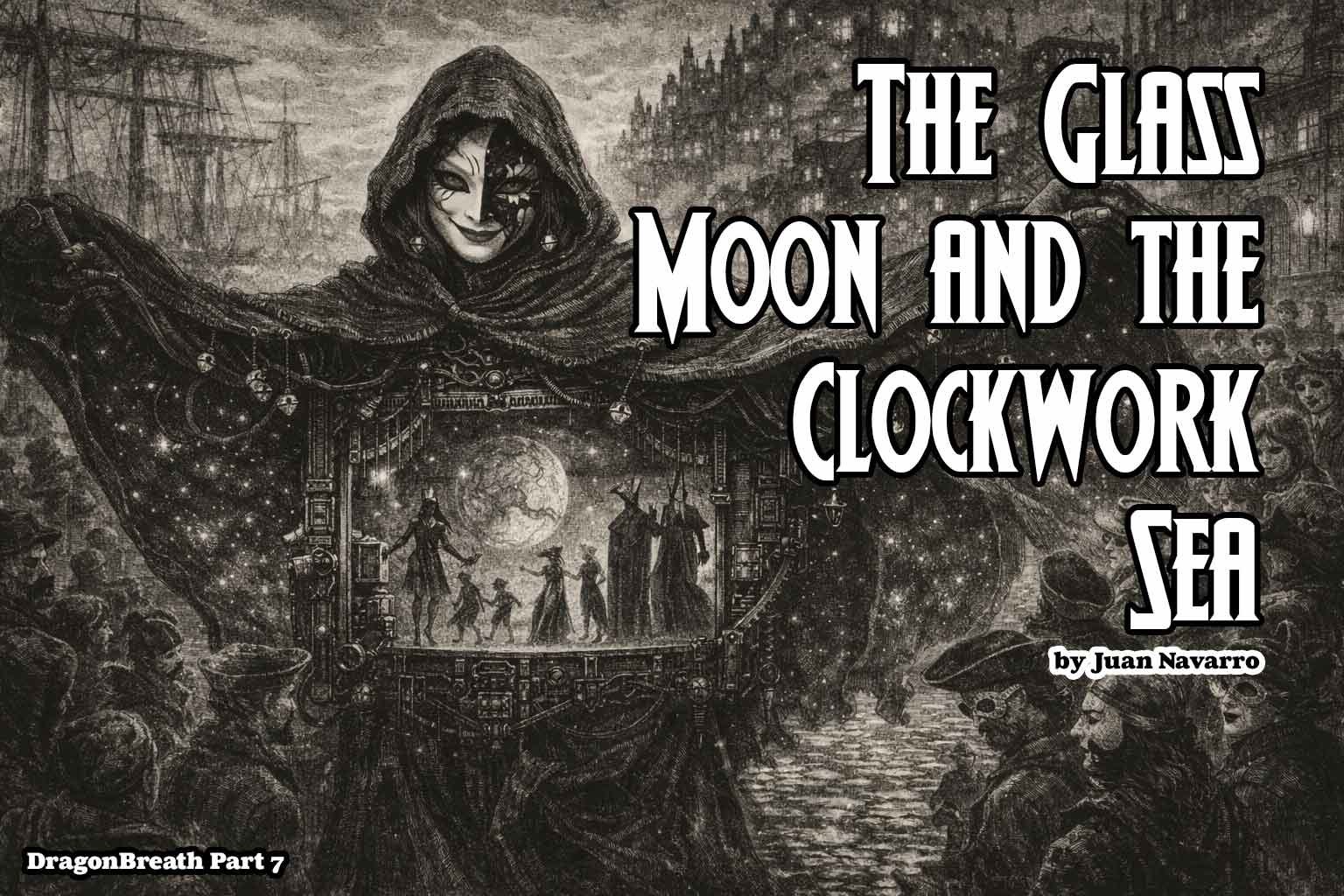
In the middle of the noise, with bells ringing, stood Zayo Tea-Haros, turning a dirty dockside street into a stage of gears and glass. A hood shadows her brow, and beneath it a half-mask, white as porcelain and split by cobalt streaks, smiles in a way that may not belong to her mouth. Bells stitch her sleeves, laughing silver with every turn of her wrist. She dresses like a jester who stole a cathedral: motley seams threaded with brass ribs, velvet that drinks light, silk that spills stars. Her cloak is vast and impossibly layered, made of smoke and mirror, gearwork and night sky, folding around her like a stage, a weapon, a secret. When she bows, the world leans closer.
On a crate. Like it was a throne.
Bells stitched into her sleeves giggled whenever she moved, which was often. Each motion—shoulder roll, hand flourish, a snap of her arm—radiated urgency, muscles taut and alive under frayed velvet. Silver laughter. The sound of coins learning how to gossip. Her cloak snapped behind her, the slick of old sweat in the scalp of her neck just catching the salt air, patched velvet stitched with brass gears and hidden wires and several terrible decisions that had survived long enough to become fashion.
Sleeve tried to shoulder through.
A thick forearm blocked him—dockhand, broad as a door.
“Show,” the man grunted, like that explained anything.
“I’m working,” Sleeve snapped, the words already thin with panic. “Move.”
The dockhand laughed, not cruel, just dumb with morning. “We’re all working, boy. She’s making it worth it.”
Sleeve blinked. “By… standing in the road?”
“By making it feel like we’re not drowning,” the man said, and then he turned back toward the crate like it was a chapel.
Sleeve looked for another route. The street behind him was tightening too, with more people piling in, drawn like iron filings to a magnet made of noise. He was trapped between a deadline and a performance.
Stillness was death here. Not metaphor. Literal.
Sleeve tried to slip along the edge, hugging the fish-stall. A woman filleting eels didn’t look up. Her knife did—sleeve adjusted course.
Zayo clinked her tin cup, and the sound rang out with an odd, resonant clarity, a little too crisp to be ordinary. The street’s noise stuttered, as if every voice and shoe scuff had been trimmed away along the cup’s sharp pulse. People felt it—a ripple running through the humid air, a hush that made everyone lean in, uncertain whether magic or mischief had just called their attention.
“Gather ’round, you drunkards and dreamers!” she sang, voice bright as a thrown coin. “Come close, nobles with soft hands and sailors with softer brains! Step right up, children of Essidarius—descendants of gods, mistakes, and one-night stands the universe has been regretting ever since!”
Laughter popped through the crowd like thrown pebbles. Coins chimed. Someone booed because Oceanforge believed heckling was a civic duty.
Sleeve found a gap—finally—and took it.
Until Zayo’s eyes flicked, too sharp, and landed on him like a hook.
“Oh!” she cried, pointing like she’d discovered a new species. “A runner-boy! Look at him—legs like lies and a face like trouble. He’s carrying secrets for men too cowardly to carry their own!”
The crowd turned as one. Suddenly, Sleeve was in a ring of faces.
He kept moving. He did not look at her. He did not acknowledge. A runner did not get involved.
Zayo leaned forward, sniffed the air theatrically, then wrinkled her nose.
“And he’s got something expensive,” she announced, delighted. “You can tell by the way he’s sweating like a priest in a brothel!”
Sleeve’s stomach dropped, making him feel like he might fall over.
His hand went to his satchel by reflex.
The Bleed Stone in the padded pouch pulsed once, warm and faintly alive, as if it enjoyed being mentioned. For an instant, a vision flickered across Sleeve’s mind: pale hands pressing the stone into trembling earth, a sky split open with hurtling stars, a scream snatched away by silence. His breath caught; the world distorted around the edges, the noise of the crowd briefly distant under the crush of borrowed memory. The sensation tugged his focus inward, making him stumble for half a step until the image vanished, replaced by the gritty pulse of Oceanforge and the weight of eyes. He blinked hard, shaken, and realized too late he had drawn attention.
A few people turned to look, their eyes suddenly more interested. In Oceanforge, paying attention was just another way of wanting something.
Sleeve pushed forward, but the crowd closed in again. Some were curious, some amused, and some looked for a chance to steal if Zayo’s joke gave them an excuse.
“Move!” Sleeve snapped, trying to sound older than he was.
Zayo lifted her hands like a priest blessing a congregation. “Don’t panic, boy! I won’t rob you. I only rob the rich, the stupid, and the ones who deserve it!”
She paused, looking him up and down with a grin.
“…So you’re safe. For now.”
The crowd laughed again, and the tension eased a little. Sleeve took his chance, ducking under an elbow and stepping over a rope.
Then his foot slipped on fish slime.
He went down hard.
His satchel hit the ground. The world seemed to tilt. For a moment, Sleeve saw the pouch move and felt the Bleed Stone shift, like a heart missing a beat.
The crowd tensed, hungry for motion.
A hand shot out.
Another closed in. Sleeve scrambled to his satchel, but before he could run, Zayo’s boot landed on the plank next to his hand.
Not on him.
It was close enough.
Tok.
The sound was sharp and final. The crowd stopped moving.
Zayo didn’t smile.
Not for a moment.
“Careful,” she said softly, and the gentle tone was the dangerous part. “That boy is working. And if you pick his pocket, you’ll have to answer to whoever sent him.”
There was a ripple in the crowd at those words, a wariness that ran deeper than fear of the street toughs. In Oceanforge, everyone knew there were authorities no one saw—old guilds, magisters with hidden rings, and the city’s hungriest magic that watched from the cracks. Nobody wanted their attention, not for a single coin.
A dockhand scoffed. “And who’s that?”
Zayo’s grin returned, bright and a little off. “Oh, I don’t know. Some merchant. Some Navigator. Some priest with bad habits. Or,” she tilted her head, bells whispering, “maybe the city itself.”
No one liked that answer.
The hands that had reached out pulled back.
Sleeve stood up, his face hot, ready to run.
Then Zayo hooked him again—not with fear this time.
With a chance.
She leaned in so only Sleeve could hear, her breath carrying hints of spice, cheap wine, and the sort of boldness that led to trouble.
“Runner,” she murmured, “you’ve got two choices.”
Sleeve glared. “I’m late.”
“Everyone’s late,” Zayo said. “We’re all late to our own funerals. Listen.” She nodded toward the crowd. “I’m blocking the street because I’m doing you a favor.”
Sleeve blinked. “By trapping me?”
“By hiding you,” she said, her eyes glittering beneath greasepaint. “You’re carrying something that makes men act foolish. Foolish men do violence. I make them laugh instead.”
Sleeve’s mouth went dry. He looked around and noticed two tough-looking sailors watching him too closely. When Zayo called him out, they moved closer, but when she stomped and said Tok, they stopped.
Zayo’s eyes flicked toward them and back.
“Now,” she said, louder, showman’s voice back, “since you’ve already spilled your dignity on my stage, you might as well earn a coin.”
Sleeve stared. “What?”
Zayo grabbed his wrist, light and quick, not giving him time to protest, and hauled him up onto the crate beside her like a prop she’d found in the street.
The crowd cheered, as they always did when someone else was embarrassed. It made their own problems feel smaller.
Sleeve tried to yank free. “I’m not—”
Zayo slapped a tin cup into his hand. “Hold this,” she hissed, still smiling for the audience. “And look miserable. You’re a natural at it.”
Sleeve’s fingers closed around the cup.
Coins were already clinking in it. Someone tossed one to see if it would land. It did.
Zayo lifted her hands, bells laughing.
“Ladies and liars!” she cried. “Behold! A messenger of Oceanforge—swift as gossip, doomed as honesty!”
Sleeve’s face grew so hot he thought everyone could see it.
Zayo leaned close again, teeth barely visible behind the grin.
“Stay still,” she whispered. “Just long enough to live.”
Then she started.
Not the jokes.
Not the insults.
Not the easy bait she used to hook the bored and the cruel.
This was her other side.
The dangerous side.
Zayo shifted her stance, stepping back onto the crate so that she stood higher than the crowd and to Sleeve’s left, with the audience arrayed loosely in a wide arc below. Her toes were just short of the edge, the wood creaking beneath her boots. Sleeve found himself pressed close at her right, the surge of people behind him and the makeshift stage between them and the dock stalls. From this vantage, Zayo faced both him and the gathered crowd. Then, she drew a slow circle in the air with one gloved finger. The bells at her cuffs did not giggle now. They chimed in a measured, deliberate way.
Then she unfurled her cloak.
It did not simply spread.
It assembled.
The velvet panels snapped outward and locked with a quiet series of clicks, hidden brass ribs extending like the bones of some mechanical wing. Thin rods sprang from the hem, forming a small proscenium arch no bigger than a market stall. Silk curtains fell from nowhere. Tiny lantern-globes blinked to life along the frame.
At first glance, it was a puppet stage. Clever. Portable. The sort of contraption a master street-performer might drag from port to port.
But then the silk darkened.
Not dimmed.
Deepened.
The velvet changed into something endless. The black swallowed the crowd’s gaze. Shallow sounds from the street faded away, hushed as if cloth could muffle the city itself. Sleeve felt a thin chill, a small tightness in his chest, as if the air itself recoiled from what lay beyond. No detail, only depth—the fabric opened into an expanse that stretched farther each time he tried to measure it. For a moment, the crowd leaned closer, uncertain whether this was trickery or real magic. Everyone wondered if they were seeing the work of gears and mirrors, or if something stranger shimmered just behind the cloth.
Stars kindled.
Not painted stars. Not sewn beads.
Points of silver light, flickering with depth, winking in layered distances that should not have fit inside cloth. Some drifted—some pulsed. One flared and vanished entirely.
A soft hum started, too low to be a real sound and too steady to be wind. It vibrated through the wet stones under their feet and through Sleeve’s bones.
Zayo lifted her hands.
From her sleeves slipped strings of nearly invisible filament, each catching starlight like spider silk. At their ends dangled small marionettes—gods carved from driftwood and brass scraps, jointed at elbow and knee. She twitched her fingers, and they began to move.
But their shadows did not match them.
Behind the small, real puppets, their shadows grew huge against the deep black of the cloak. When the wooden god moved gently, its shadow became giant and bright. When the brass puppet stumbled, its shadow broke apart like stained glass.
And beneath them—
Another layer.
The cloak rippled, and projected light poured through the silk as if from some unseen lantern beyond the world. Constellations wheeled. A sphere of pale glass formed slowly in the distance—perfect and hollow. Not just an image.
A place.
It was at once a stage, a painting, a shadow-play, and a window.
You could see the seams.
You could not see the end of it.
A small wooden moon rose on a rod in Zayo’s hand, charming and crude.
Behind it, the vast Glass Moon formed—translucent, luminous, cracked faintly with veins of inner light. The puppet moon turned. The projection moon turned. The shadow moon fractured across both.
Real things, illusions, and skill all blended together.
The crowd inhaled as one body.
Not because they didn’t understand what they were seeing.
But because they knew exactly what it meant.
Zayo did not pretend to hide the mechanism. The brass ribs were visible. The rods gleamed. The strings shimmered.
And yet—
The stars were deeper than cloth.
The light seemed older than the stage itself.
Sleeve’s mouth went dry.
He had seen dock magisters throw glamours for coin. He had seen priests coax sparks from bone-charms. He had seen Navigators bend small winds around a mast like a polite suggestion.
The feeling charged the air, more than just a clever trick. This was art sharpened into something like a spell.
The wet stones on the street reflected the starlight in shaky puddles, as if the sea had come to watch. The bronze railing glowed a little. Even the fish on the tables seemed to shine like gifts.
Zayo stood in the middle, small but fierce, one foot on the crate and one knee bent like she was ready for a fight. The bells on her sleeves now rang softly with the hum, matching a rhythm that made Sleeve uneasy.
When she spoke, her voice seemed to come from three places at once.
From her mouth.
From the small stage before her.
And from somewhere deeper, where the stars hung.
“In the beginning,” she said softly, and a wooden god raised its carved hand, its shadow swelling to eclipse half the cloak, “there was a moon made of glass.”
The puppet moon rose on its rod.
Behind it, the vast Glass Moon bloomed in impossible depth.
And for a heartbeat—
It did not feel like a performance.
It felt like something the world had been waiting to remember.
“In the beginning,” Zayo murmured, voice dropping into something intimate, “there was a moon made of glass.”
A sphere formed on the cloak-sky—translucent, glowing, perfect, and hollow.
Sleeve’s grip tightened on the cup.
He felt the Bleed Stone in his satchel pulse faintly, as if it recognized the story. The pulse quickened, hot and anxious against his hip, and for a heartbeat, Sleeve sensed a spike of longing or memory radiating from the stone itself. His mouth went dry, his chest tightened, and a strange mix of sadness and anticipation washed over him. It felt not just alive, but somehow listening, as if Zayo’s tale touched a wound long hidden in the stone’s core, stirring his own restlessness in response. The urge to run hit him so hard he almost did—feet tensing to bolt through the crowd, away from anything that could make his life bigger or more dangerous than errands and deadlines. Instead, he froze for a moment, swallowed hard, and chose to stay rooted, uncertain whether it was fear or hope keeping him in place. For the first time, the stone’s longing felt like a silent question pressing against his ribs: Was he running from danger, or from what he might become if he listened too closely?
“Inside the Glass Moon,” Zayo continued, “the first gods played dice with starlight and called it wisdom.”
Tiny sparks rolled across the cloth—bright squares tumbling silently like bones. Puppet silhouettes moved behind the moonlight: jointed little godlings posturing, boasting, bored.
Zayo threw her voice into them, switching tones fast as breath:
“Behold my eternity!”
“Behold my perfection!”
“Behold my—oh no, I dropped it.”
Nervous, relieved laughter broke out.
Sleeve didn’t laugh. He couldn’t; his chest felt tight.
Zayo stomped her boot.
Tok.
Tok.
The night sky changed. The stars faded into bronze, and the cloak transformed into a sea of gears. All around, the gears glowed red like fresh wounds in the depths, their turning relentless and feverish. It was a world that never slept, never forgave, never stopped.
“The Clockwork Sea,” Zayo said. “Vast. Hungry. Beautiful. Turning forever because nothing had yet told it to stop.”
Sleeve swallowed.
He had heard chains groan at night like old beasts. He had heard the harbor’s deep creak like something huge shifting beneath.
Now his brain did the stupidest thing: it believed her.
“And then,” Zayo whispered, eyes bright, “the gods got bored. Which is the first cause of all disasters?”
A puppet god slipped.
Then another.
Then all the puppets fell into the sea of gears below, clanging loudly like dropped silverware at a fancy dinner.
The gears glowed red along their seams.
“Divine blood,” Zayo said softly, “in the works.”
Shadows rose from the gears—huge, strange shapes with metal ribs, glowing eyes, and bone covered in bronze. These things were learning to stand.
The Age of Horrors.
A child whimpered. An adult muttered a word. Someone crossed themselves so hard their knuckles popped.
Sleeve’s cup trembled in his hand.
Zayo held the fear just long enough, then deadpanned:
“Trust me, I’ve seen more dignity at my cousin’s wedding.”
The street was filled with laughter, everyone relieved after the tension.
Sleeve laughed too, a quick, surprised sound, because he realized he’d been holding his breath.
Zayo glanced at him, just a flicker, and there was something like approval there.
It felt like she had brought him into the show on purpose.
As if Sleeve had been the point all along.
When the laughter faded, Zayo lifted her hands again, and the Glass Moon on her cloak cracked, light leaking through like a wound.
“When the Glass Moon broke,” she murmured, “the gods fled.”
She tossed ground mica into the air.
It glittered, caught the Sunspire’s light, spun like tiny falling stars.
“And because we are cowards with good branding,” Zayo said, “we called the shards stars.”
The crowd looked up instinctively.
Sleeve did too.
He hated that he did.
Zayo leaned forward, voice low and private even though it carried.
“And we—little creatures—crawled out of the runoff and said the first true word ever spoken on Essidarius.”
She paused.
Sleeve felt the whole street lean.
Zayo smiled, sweet as poison.
“Mine.”
The crowd laughed, uncomfortably, because it hit too close to home.
Zayo tipped her cup, then nodded at Sleeve’s cup like it was part of the ritual.
Coins clinked into his hand.
People were paying him for standing still.
Oceanforge made even simple things like accounting a nightmare.
Zayo straightened, bright again. “Now! You want prophecy? You want doom? You want the part where the Horrors don’t sleep—just nap, badly?”
Cheers. Coins. Noise.
But Sleeve barely heard it.
Because beneath the laughter, the bells, and the harbor’s noise and smells,
He swore he could hear it.
Not waves.
Not chains.
A steady, patient rhythm.
Tok.
Tok.
Tok.
Like the world, somewhere deep and unseen, was counting down.
And Sleeve, a runner, delivery boy, and survivor, stood on a crate next to a clown and realized something with sudden clarity:
He hadn’t been delayed.
He’d been intercepted.
The city had delivered him a message.
And it had used Zayo Tea-Haros to deliver it.
The show ended the way all good things in Oceanforge ended: with applause that sounded like hunger and money that sounded like forgiveness.
Coins fell, though not many—Oceanforge never gave much, just enough to keep the show going. The crowd broke up, moving again like a tide. People laughed as they left, pretending it had all been just a joke.
Zayo bowed low, her bells ringing. The cloak-stage folded up with neat clicks, brass ribs sliding into velvet, curtains hiding the stars. The night sky faded away.
Sleeve stayed on the crate, holding the cup as if it proved he’d been caught up in the show.
Zayo took it from his hands without looking. “You did great,” she said brightly, then added in a lower voice, “in the way a drowning man does great when he remembers to inhale.”
“I’m late,” Sleeve hissed, snatching his satchel strap tighter across his chest. The Bleed Stone warmed through the padding like a fever.
Zayo’s grin didn’t change, but her eyes shifted, taking quick stock with a streetwise look. “You’re alive,” she said. “In Oceanforge, that’s early.”
She jumped down from the crate and walked away. The way she moved, relaxed and confident, almost like a cat, made Sleeve uneasy.
He got off the crate and moved too, not because he wanted to, but because the lane was still crowded and people and carts blocked his path. He slipped through the crowd, turning sideways, ducking under a tray of oysters, and stepping over arguing urchins without stopping.
People in Oceanforge didn’t have a word for parkour yet. Here, it was just a way to survive with a bit of style.
He vaulted a low barrel, landed, cut under a hanging line of laundry, and hit the next alley that spidered up toward the cliff stairs.
And that’s when he realized the crowd hadn’t just blocked his way.
It had also quietly cleared the street around him.
Like someone had wanted him to be seen.
A shadow peeled off the corner behind him.
Then another.
Three men followed: two big, rough types who made a living off others’ misfortune, and a third who looked plain and calm. That calmness was the warning sign.
Sleeve’s pulse spiked.
He didn’t stop running. Stopping was consenting.
He cut hard right into a narrow passage between buildings, where the stones sweated algae, and the air grew cooler, fish smell replaced by damp iron. A drain grate hissed steam at his ankles like a warning.
Boots pounded behind him. The two tough men made plenty of noise as they showed off. The third? Sleeve could barely hear him.
That meant he was keeping up.
Sleeve cursed quietly and ran up the wall: one foot on the stone, a quick push, grabbing a beam, and swinging himself up. He climbed onto a low roof ledge covered in salt, then ran along the shingles and jumped.
A hand caught his ankle while he was in the air.
He hit the far ledge hard, ribs biting, and looked down.
One of the tough men hung from the edge with one arm and held Sleeve’s ankle with the other, grinning like he’d won something.
“Cute,” the man said. “Now give us the pouch.”
Sleeve kicked, hitting the man’s knuckles. The bruiser yelled, lost his grip, and fell out of sight with a curse.
Sleeve didn’t wait. He ran.
He leapt across a gap, rolled, came up, darted down a slanted roof toward a stack of crates by the fish stalls again—back toward the main lane.
Back toward where Zayo had been.
Because even a runner knew when the city was herding him, and right now the city had him by the shirt. A salt-crusted sign above the lane groaned as he passed, swinging hard to block his path left, its hanging chain croaking like a warning. Overhead, gulls burst from a rooftop all at once, blotting the sun and then wheeling in a tight circle down the alley he was already sprinting toward. Sleeve felt the current of movement shift. It wasn’t random; the street itself nudged him, closing off ways he might have escaped and lighting the route the city wanted him to take.
He dropped from the roof onto a canvas awning, bounced once, then landed He dropped from the roof onto a canvas awning, bounced once, and landed in a crouch behind a stall with a steaming kettle. The vendor screamed, sounding more annoyed than scared, and nearly slammed into Zayo Tea-Haros, who was standing alone as if she’d been waiting.
Of course, she had been.
“Ah,” she said pleasantly. “Here comes the second act.”
Sleeve’s mouth opened. No sound came out. His lungs were trying to negotiate.
“They’re after the stone,” he managed.
Zayo tipped her head. “Yes.”
““I suspected,” she corrected, like a teacher kindly grading a wrong answer. “Now I know.”Now I know.”
The first bruiser stumbled into the lane, panting, eyes wild. The second followed, a knife in his hand that looked like it had tasted ribs before. Behind them—farther back, slower—came the third man, walking like he owned time.
The bruisers saw Zayo and hesitated. Everyone in Oceanforge knew better than to touch a performer mid-street. Not because performers were sacred.
Because performers had connections.
“Out of the way, jester,” the knife-man snarled. “This ain’t for you.”
Zayo sighed, as if someone had asked her to solve a problem. “Everything is for me,” she said, then smiled at Sleeve. “Stay close, runner.”
Sleeve started to say, I don’t want to stay close to you, but it came out as, “Why?”
Zayo’s bells rang softly, sounding pleased. “Because you’re useful.”
Then she moved.
Not toward the muggers.
Toward her cloak.
She opened it with a practiced flick, and the velvet deepened again. Brass ribs locked in place, the stage formed, and the arch appeared from the cloth as if a machine were coming to life.
The crowd, which had started to leave, slowed down, drawn back by curiosity. People loved a fight almost as much as a good story.
Zayo raised her hands, and the stage lit up, not with lanterns, but with a cold, star-like glow.
The Glass Moon appeared again across the velvet, cracked and luminous.
“Gentlemen!” Zayo called brightly. “Welcome to my sermon!”
The first bruiser lunged.
And the street changed.
Not physically. Not enough to make a priest scream heresy.
But it was enough.
The stones under the bruiser’s boots slid, like the lane had become a deck in a rough tide. He staggered, arms windmilling, and smashed shoulder-first into a fish-stall table. Silver flanks exploded into the air like coins thrown by a generous god.
The knife-man recovered fast—he was used to chaos—and charged anyway.
Zayo twitched her fingers.
Threads flashed.
A marionette dropped from the cloak-stage: a small brass figure with a smug face, long arms, and thin legs. It danced once, almost mocking, then its shadow grew larger.
Not the puppet.
The shadow.
A huge shadow, shaped like a foolish god, all elbows and pride, stepped across the lane in deep blackness. The knife-man swung at it without thinking, and his blade passed through the shadow.
The blade struck the bronze railing with a shriek, vibrating with a loud clang and making his whole arm go numb. The knife-man went flying sideways as if a cathedral had slapped him. He hit the ground hard, bounced, and didn’t get up right away.
Sleeve stared, feeling both amazed and angry. “You can do that, and you use it for street shows?”
Zayo didn’t look at him. “You can run like that, and you use it just for errands?” For a moment, she glanced away, her smile slipping and her eyes shadowed with something older than performance. “Not everything worth doing belongs on a stage.”
He had to admit that was fair.
The first bruiser scrambled upright, grabbed a crate hook, and came for Sleeve, charging past the cracked bronze post that marked the lane’s edge. Sleeve glanced left at the post, its surface greened with age and dented from years of collisions—a fixed point amid all the shifting chaos—knowing he’d need room to maneuver. Because when men can’t hit the magician, they hit the assistant.
Sleeve reacted on instinct. He slid sideways toward the bronze post, used it to anchor his pivot, and then kicked the bruiser’s knee from the side. The man howled and swung wildly.
“Runner’s got hands,” Zayo remarked, almost approving.
“I’m still alive,” Sleeve grunted.
“Same thing.”
The bruiser lunged again.
Zayo flicked her wrist, and the stage projected a burst of starlight into the man’s eyes—a flare like looking into a white lantern. He recoiled, blind, and Sleeve took the opening, slamming his shoulder into the bruiser’s chest and driving him backward into a pile of oyster baskets.
The man went down in a tangle of curses and shells.
Sleeve backed away, breathing hard, clutching his satchel as the Bleed Stone inside seemed to burn.
He looked for the third man.
The calm man.
He was closer now. Still walking. Still unhurried.
As he reached the edge of the light, Sleeve saw what was off about him: he didn’t have a knife, nothing that obvious.
A thin wire looped between his fingers, almost invisible. It was a garrote, meant for silent work.
He was an assassin.
The assassin’s eyes weren’t on Sleeve.
They were on Zayo.
Because Zayo was the threat.
Zayo met his eyes, and her grin disappeared, dropping away like a mask.
“Oh,” she said softly. “So that’s who wants the stone.”
The assassin moved.
Fast.
Not bruiser-fast. Not street-fast.
Professional-fast. A line drawn in the air.
The wire snapped toward Zayo’s throat.
Zayo didn’t dodge.
She performed.
She threw her cloak-stage outward like a net.
The crack in the Glass Moon widened and spilled hard, pale light. The assassin’s shadow hit the velvet and, for a moment, stuck as if nailed to the moon. He struggled, wire shaking, but his feet paused—just long enough for everything to change.
Zayo’s hand darted into the folds of her cloak and came out with something small and ugly: a puppet no bigger than a rat, made of bone, brass, and fish-spine, its amber eyes catching light like cruel little suns.
She whispered a word that Sleeve didn’t understand.
The puppet bit the air.
And the assassin jerked as if something unseen had sunk teeth into his wrist.
The wire fell.
The assassin recovered instantly—because assassins always do—reaching for a secondary blade tucked in his sleeve.
Zayo was already moving.
Not magic now.
Just violence.
She stepped in close, too close for knives to be elegant, and drove the heel of her palm into his throat. Not crushing. Not theatrical. Efficient. His breath left him in a wet gasp.
He staggered back.
Zayo’s other hand moved quickly—she held something thin and bright, maybe a needle or a piece of glass, Sleeve couldn’t tell—and she pushed it into the soft spot under his jaw, like pinning a note to a board.
The assassin froze.
His eyes widened, surprised more than hurt, as if he’d always expected to die, just not here in a street full of fish and laughter.
He collapsed quietly, folding down like one of Zayo’s marionettes.
The lane held its breath.
Then someone screamed.
Then everyone remembered they were late and alive, and that they should not be here when the authorities arrived.
The crowd scattered like startled birds.
Zayo stood over the body for half a second, watching it like she was listening for a final tick.
Then she let out a breath, and her grin came back—smaller, more private.
Sleeve stared at her. “You killed him.”
Zayo shrugged. “He was going to kill me.”
“And the others?”
“They were going to kill you,” Zayo said, as if that was the more annoying thing. She nudged the fallen assassin’s boot with her toe, thoughtful. “But mostly, they were going to take the stone.”
Sleeve tightened his grip on his satchel strap. “Why do you care who wants it?”
Zayo looked at him then, really looked, and Sleeve suddenly felt exposed, as if he were standing in the Sunspire’s light, seen too clearly.
“Because,” she said lightly, “I like knowing which hands are reaching into my city.”
Somewhere behind her words, the city itself seemed to listen, a presence in the stones and steam, attentive and unsettled, as if Oceanforge didn’t just belong to its people, but chose who belonged to it.
Sleeve hesitated, breath shallow as the crowd faded. He glanced at the alleys, the glinting bronze posts, and clutched his satchel tight. For an instant, he considered vanishing into the maze like he always did. But instead, he made a decision. He slipped along the edge toward the old district, where he knew Old Marro the healer kept her door cracked for runners in trouble. He would find her, find someone who could help him keep the Stone hidden, or at least advise him on who else might be hunting it. The city might be watching, but for the first time, Sleeve would choose a path instead of just fleeing down the closest one.
“It’s not your city,” Sleeve snapped, immediate and childish and true.
Zayo smiled wider. “Exactly.”
She turned away, folding her cloak with practiced movements. The stars disappeared, the stage became just cloth again, and the puppet-rat slipped into the velvet like a hidden secret.
Sleeve took a step after her. “Wait—what does it mean? The story—today—why—”
He hesitated, a chill running through him as the ordinary street seemed suddenly full of shadows and hidden eyes. Zayo was already slipping away, but her words lingered. A warning or an invitation, he couldn’t decide. Sleeve felt the press of the Bleed Stone and wondered if this was only the beginning of something far larger than a stolen moment or a missed delivery. There were questions now that would not stop gnawing at him: what dangers had he inherited just by listening, what new trouble might already be on his heels? Part of him wanted to turn back, beg for answers, or run until none of this could follow. But another part, sharp and restless, wondered if Zayo’s story was now his too—and, if so, what it would cost by the time the city was finished with them both.
Zayo paused at the mouth of the lane where the harbor wind pushed in, carrying steam and salt and the sound of chains.
She didn’t look back.
“Means,” she said, “that someone thinks you’re important.”
Sleeve’s stomach sank. “I’m a runner.”
Zayo lifted one shoulder, bells chiming softly. “So was a spark once. Then someone decided to aim it.”
Then she walked away into the busy city, into the noise and the next crowd, disappearing as if she’d been practicing it long before she learned magic.
Sleeve stood alone in the lane, breathing hard, hands shaking, satchel warm against his ribs.
The Bleed Stone pulsed once, like a heartbeat.
Tok.
Tok.
Tok.
Tok.
Tok.
He looked down the street where Zayo had gone, then up toward the cliff terraces and the indifferent windows, then out toward the harbor where the masts stabbed the sky like prayers.
He had deliveries to make. Deadlines. A boss. A life that wanted to stay small.
But the city felt different around him, even though nothing had moved.
And somewhere inside Sleeve, under all the running, errands, and his habit of staying unnoticed, something new had started to grow.
Not courage.
Not destiny.
Just a question.
Who wanted the stone?
And why had Zayo Tea-Haros looked almost… satisfied to find out?
Sleeve hitched his satchel higher and ran.
Because stillness was death.
And because, whether he liked it or not, Oceanforge had just delivered him another message.


