
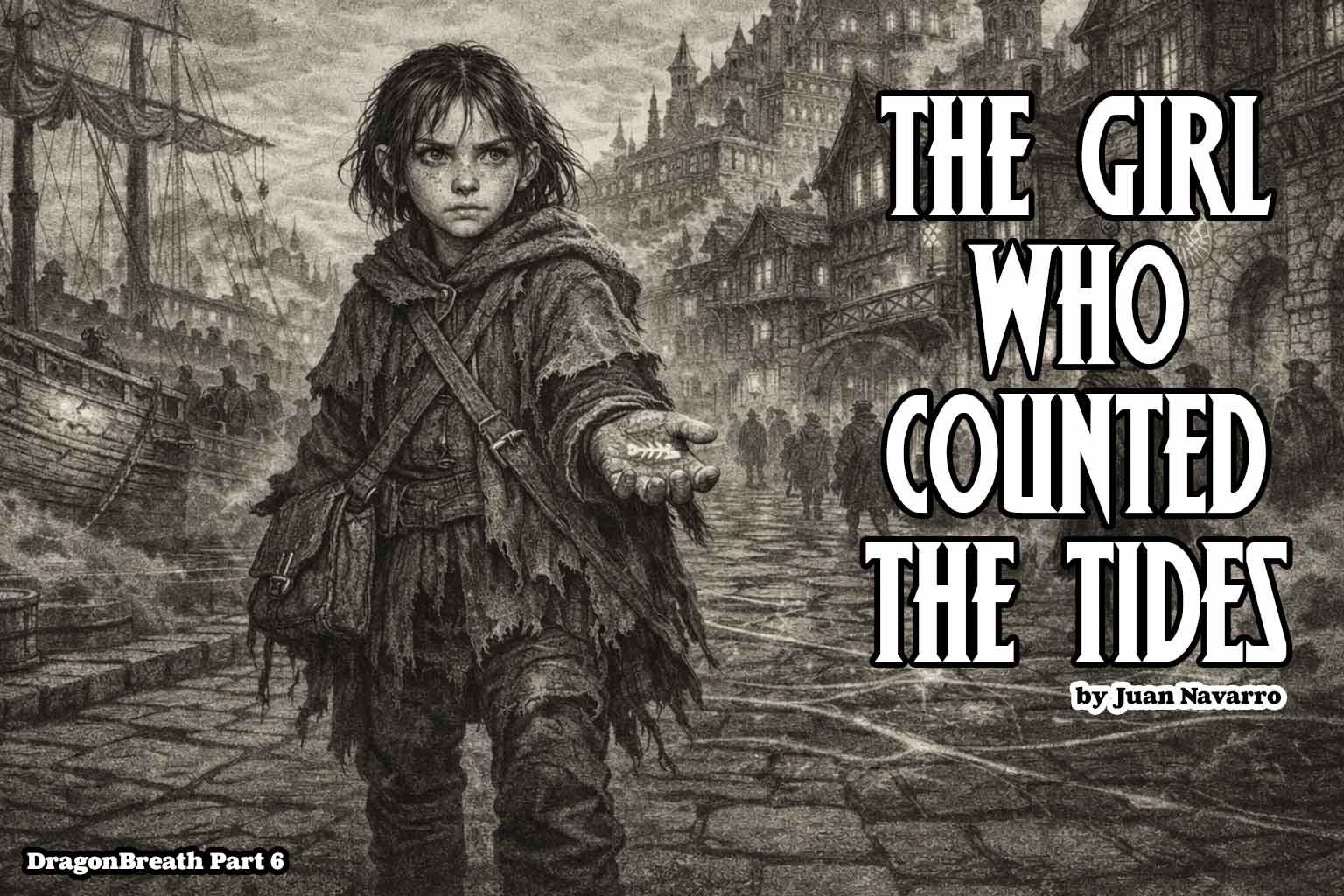
THE GIRL WHO COUNTED THE TIDES
DragonBreath Part 6
Mira woke before the bells, the wards coughing again.
That was how you knew the city had shifted its weight in the night.
Not loudly. Oceanforge never bothered with loud when it could do subtle. The ward stitched into the doorframe—a thin blue thread woven through salt and bone dust—flickered and made a sound like a throat trying to clear itself without waking anyone.
Mira lay still, one eye open, counting heartbeats.
One.
Two.
Three.
The coughing stopped.
She exhaled.
“Still alive,” she whispered—a report and a prayer in one.
The room above the fishmonger’s shop smelled like brine, old smoke, and her mother’s headache. Dawn leaked in through warped shutters, light bent strangely by the fog rolling off the river. Everything in Oceanforge looked wrong until midday. Shadows stretched sideways. Buildings leaned like drunks conspiring.
Her mother groaned from the cot.
“That wasn’t me,” Mira said preemptively.
“Liar,” her mother croaked, not opening her eyes. “You touched something.”
Mira padded across the floor, toes numb from the damp. She knelt by the charm-table and checked the setup: copper wire still intact, salt undisturbed, driftglass humming faintly.
“I only adjusted the sympathetic loop,” Mira said. “It was bleeding probability.”
Her mother opened one eye. “You’re nine.”
“And you taught me how.”
A pause.
Then a tired smile. “Get breakfast. Don’t summon anything. Don’t antagonize priests. Don’t get seen.”
“Which one first?”
“All of them.”
Breakfast was bread that had once been ambitious, and hot water pretending to be soup. Mira ate quickly, slung her satchel over her shoulder, and slipped outside before the city noticed her too much.
Oceanforge in the morning was a creature stretching its joints.
Ships groaned at the dock. Steam hissed from vents in the stone streets. Bells rang from towers that didn’t agree on the time. The river moved thick and slow, carrying silt, secrets, and reflections that didn’t always line up with what stood above them.
Mira ran errands.
She always did.
First stop was Old Finard’s shed near the quay, where nets dried like dead skin and gamblers prayed louder than priests. Finard looked her up and down with the practiced eye of a man who had lost at everything except surviving.
“Morning, crow-girl,” he said. “Your ma still bending the world for scraps?”
“She bends it better than you bend cards,” Mira said.
He laughed and handed her a folded note sealed with wax that smelled faintly of fish and guilt. “Bathhouse on the east quay. Don’t open it.”
Mira nodded solemnly.
She opened it three steps later.
It was a list of names and times. She didn’t understand it all, but she memorized the shape of it anyway. Shapes mattered.
The bathhouse was already steaming when she arrived, voices echoing through stone and tile. A woman with silver teeth and an arm full of old scar-runes took the note, glanced at Mira’s hands, then passed her a small vial stoppered with cork and string.
“Careful,” the woman said. “That’s distilled grief.”
Mira held it up to the light. The liquid inside moved as if it were thinking about crying.
“Who’s it for?” Mira asked.
The woman shrugged. “Someone who paid.”
Mira tucked it away.
Outside, the city felt sharper.
That was when Mira felt the tug.
A wrongness in the air, like static crawling across her skin. The bone fish charm in her pocket warmed, then went cold.
Big magic.
Not hedge work. Not alley charms or backroom favors.
Navigator magic.
Mira ducked instinctively beneath a stone archway and pressed herself flat against the wall. She whispered the old words—not a spell exactly, more like a convincing lie whispered to the world.
“I’m small,” she murmured.
“I’m boring.”
“I’m not worth the effort.”
The magic passed overhead like a searching hand that decided she wasn’t worth closing its fingers around.
She waited anyway.
When she emerged, the street was louder, busier—and something else had changed.
The Vomiting Dragon’s doors burst open.
A man stumbled out, half-laughing, half-dying, hair a disaster, shirt misbuttoned, boots in disagreement with each other. He blinked against the daylight as it had personally offended him.
Mira froze.
He wasn’t dangerous-looking. That was the problem.
He had the posture of someone who had never learned how to be afraid correctly—soft around the edges, eyes too open, too curious for a city like this. He tripped on the threshold, caught himself on the doorframe, and muttered something about “never again” that sounded deeply unconvincing.
Someone inside the Dragon yelled after him, “YOU OWE FOR THE TABLE!”
The man waved vaguely in surrender and staggered away, nearly colliding with Mira.
“Oh—sorry!” he said, smiling like a fool. “Didn’t see you there.”
Mira stared.
She felt it then—a thin thread of attention, not magic exactly, but importance. The kind that dragged trouble behind it like a shadow that didn’t know when to let go.
“You should watch where you’re going,” Mira said carefully.
He nodded earnestly. “Absolutely. Very good advice. I will take it under consideration immediately.”
He walked directly into a post.
Mira winced.
When she looked again, he was already being half-dragged away by a well-dressed man with sharp eyes and a permanent look of regret.
Mira stood still until the thread snapped.
Then she breathed again.
“Poor bastard,” she muttered.
The rest of the day went wrong in smaller ways.
Not the cinematic kind of wrong—no swords drawn, no screaming mobs, no gods cracking the sky open like an egg. Just the petty, constant cruelty of Oceanforge doing what it did best: pinching. The city didn’t need to kill you to ruin you. It could simply keep leaning, a little more, a little more, until your bones did the breaking for it.
Mira tried to shake off the thread-feeling she’d had near the Vomiting Dragon—like she’d brushed past a hook embedded in the world and it had snagged her sleeve. She told herself it was nothing. A drunk noble. A soft man with soft hands and a hard future. Not her business.
But Oceanforge did not care what your business was.
She cut down a narrow alley that smelled like wet copper and fried eel, heading toward the river steps where the shrine-stones sat. The charm in her pocket—the little bone fish—had gone cold and stayed cold. That was a bad sign. When hedge charms cooled, it meant they’d either done their job or something bigger had leaned on them and reminded them what rank they held in the food chain.
Mira didn’t like being reminded.
She climbed down the slick stone steps to the dock shrine. It was a pathetic little thing compared to the Azure Order’s marble monstrosities—just a stack of river stones, a tar-black bowl for offerings, and a bit of old rope tied to a rusted hook like it meant something. Sailors left coins there, sometimes a ring or a tooth, sometimes a gulp of liquor splashed carelessly. People prayed to the river because the river was honest. It drowned you and moved on.
Mira knelt, pulled out her chalk, and traced the luck-sigil beneath the stones. She kept it small. Quiet. The kind of magic that didn’t get noticed unless someone was specifically looking for it.
As soon as the chalk line closed, the sigil fizzled.
Not faded. Fizzled.
Like it had been spat on by something invisible.
Mira blinked. Tried again. Same thing—spark, hiss, dead.
Her stomach tightened.
She leaned closer, eyes narrowed at the stones. Something was wrong with the shrine itself. The stacked rocks felt… heavy in the air, like they’d been soaking up attention. The bowl was fuller than usual, too: more coins than she’d ever seen there, glinting wetly in the dim light. She reached toward them instinctively—because she was nine and poor and human—and the moment her fingers crossed the edge of the bowl, a shock snapped through her hand.
Not pain. Not exactly.
A demand.
Mira jerked back, heart hammering. Her charm fish warmed in her pocket like it was laughing at her.
“Okay,” she whispered to the shrine, voice low. “I get it. You’re in a mood.”
The air around the stones felt like a held breath.
Something had been done here. A blessing turned sour—a prayer twisted. Or worse—someone had made a deal and left the shrine holding the bag.
Mira looked around quickly. The docks were busy enough to hide in. Stevedores moved crates. A sailor puked cheerfully into the river. A pair of lovers argued in whispers sharp enough to cut rope. No one looked at her.
But the shrine did.
That was the stupid part. Shrines weren’t supposed to look.
She reached into her satchel and pulled out one of her three copper bits. It felt suddenly insulting in her palm, like offering a crumb to a starving wolf and expecting gratitude.
Mira swallowed and placed the coin on the stones instead of in the bowl—respecting the boundary like a good little mouse respects a cat’s patience.
The pressure eased slightly.
Not gone. Just… less angry.
“Fine,” she muttered. “You win. You’re expensive today.”
She backed away, careful not to turn her back too sharply. Old instincts. Even if she didn’t know what she was dealing with, she knew the shape of dealing.
She climbed the steps fast, chalk still in her hand, and didn’t stop moving until she was halfway down the quay.
That was when the priest stared too long.
It wasn’t an Azure Order priest—those glittering peacocks with their sea-blue robes and polished staffs. This one wore travel-gray and carried no staff, just a small necklace of driftglass beads. He stood near a fish cart, hands folded, watching the docks like he was waiting for someone to sin on schedule.
His gaze found Mira.
And stayed.
Mira slowed, pretending to be casual. She adjusted her satchel strap and wiped her chalky fingers on her skirt, like a normal kid. She glanced at him once—quick, respectful—and looked away.
Still, she could feel it. The gaze didn’t slide off her. It stayed pinned.
The air tightened again. Not magic, not quite. Judgment.
Mira’s mother had taught her the difference early. Magic was pressure with intention. Judgment was pressured with entitlement.
She walked faster.
Behind her, the priest spoke—not loudly, not calling her out—just a soft phrase, like he was speaking to himself.
“Little hands,” he murmured. “Little knots.”
Mira’s stomach dropped.
She didn’t run. Running made you memorable.
She turned a corner, ducked behind a stack of crates, and pressed herself into the shadow. She pulled her bone fish charm free and whispered again.
“I’m small.”
“I’m boring.”
“I’m not worth the trouble.”
She didn’t believe it, but belief wasn’t required. Consistency was.
A pair of dockworkers trudged past, arguing about pay. Their voices washed over her hiding place, normal and profane. Mira counted their footsteps until they were gone.
Then she peeked out.
The priest stood at the corner now, head tilted slightly, like he could smell where she’d been. His eyes were calm. Not angry. Not even suspicious.
Just interested.
That was worse.
Mira felt suddenly like a coin in someone’s pocket—small, ordinary, already spent.
She swallowed and did the only thing her mother said worked in Oceanforge: she used the city.
She slipped out from behind the crates and merged into a group of market kids darting between stalls. She became one more skinny body in a moving swarm, one more pair of hands, one more hungry face. She let herself get shoved, stepped on, and cursed at. Better bruised than singled out.
The priest’s gaze vanished.
Or maybe it just moved to someone else.
Mira never looked back.
By midday, she was supposed to meet a runner near the copperworks—deliver a message, collect a few scraps of wax and wire for her mother. Simple. Clean.
Oceanforge did not do a clean.
The copperworks district smelled of hot metal, sweat, and sour beer. Steam vents coughed near the street, fogging the air. Mira found the runner—an older girl named Pell with a split lip and the kind of eyes that had learned never to soften. Pell handed Mira the packet without a word.
Mira tucked it into her satchel and turned—
—and her charm fish went ice-cold.
The world tilted again.
Not physically, but in that way where the air changes density, like a giant hand has pressed down on the city. People didn’t notice. Not consciously. They just got quieter. Less rowdy. Even the hawkers lowered their voices as if embarrassed to be loud.
Mira felt the pull of the tide without seeing the river.
She had miscounted.
She’d been taught the tide rules like bedtime prayers—count the bells, watch the wind, feel the salt in the air. But today the river had lied. Or someone had lied through it.
Mira realized too late that the fog rolling in was not fog.
It was ward-smoke—the residue of a big working somewhere nearby.
Her mother’s voice echoed in her head: If the air tastes like pennies and regret, you go the other way.
Mira tried to go the other way.
But the street had filled.
A wagon rolled through, its wheels carved with sigils that hummed faintly. Guards walked beside it—real guards, not dock bouncers. Their armor was neat, their posture too straight. Not city watch.
Navigator adjuncts, maybe.
The kind of men who didn’t get paid to ask questions.
Mira backed into a doorway, heart kicking. She kept her face blank, boring, invisible. She was just a kid. Just a kid with chalk in her nails.
The wagon passed.
As it did, the ward-smoke reached out like fingers.
It brushed Mira’s cheek.
She didn’t scream. She didn’t move.
But something inside her head clicked—like a lock turning the wrong way.
For a moment, she saw the city differently. Not the streets and stalls, but the currents beneath—threads of power running through stone like veins, knots of influence tied and retied, wards layered on wards like bandages over a wound that wouldn’t close. Oceanforge wasn’t a city.
It was a machine built out of compromises.
Then the moment snapped shut.
Mira blinked hard, and the normal world returned with a dull throb behind her eyes.
A headache that wasn’t hers.
She stumbled away, swallowing bile, forcing her legs to move normally. She didn’t know what she’d brushed against—only that it had brushed back.
By dusk, she limped home with chalk-stained hands and the packet of wax and wire still intact. Her feet were raw again. Her charm fish felt heavy as guilt in her pocket.
Upstairs, her mother was sitting up, eyes sharper now, hair messier, the awake that meant pain had loosened its grip but not left.
Mira froze in the doorway.
Her mother sniffed the air once, like an animal catching scent.
“You crossed something,” she said.
Mira tried to lie. She opened her mouth and failed.
“I saw someone important,” she admitted.
Her mother went still. The room seemed to tighten around that sentence.
“Did they see you?”
Mira hesitated, replaying the priest’s gaze, the wagon’s ward-smoke, the strange moment of seeing the city’s veins.
“No,” she said.
Her mother exhaled slowly, relieved—but not comforted.
“Good.” A pause. “That’s how we survive.”
They ate quietly. Outside, Oceanforge lit up—lanterns, steam, glyphs humming like insects. Somewhere distant, a bell rang the wrong hour. Somewhere closer, a shout became laughter, then silence.
The city didn’t sleep.
It only shifted.
Mira lay in bed that night listening to the wards hum steadily and strongly. Her mother’s breathing finally evened out. The bone fish charm warmed against her palm like a tiny heartbeat.
Tomorrow, she would wake early again.
As long as the city didn’t decide she was useful.
Or worse—
remembered her at all.


