


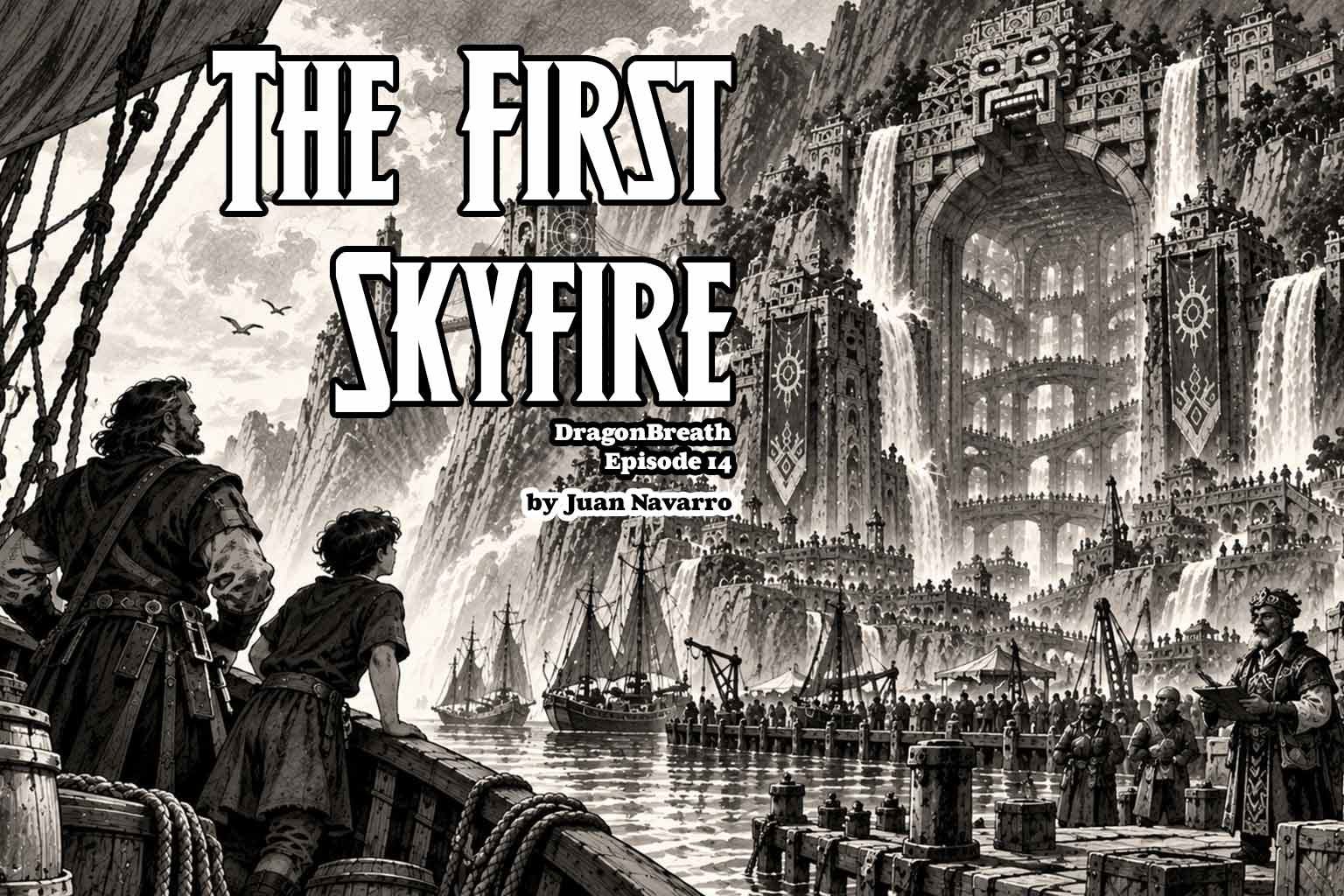
The first rule of sailing Dragonmaw Bay was simple.
Do not.
The second rule, if hunger, debt, pride, or foolishness had already broken the first, was to arrive before dusk, leave before dawn, and never stare too long at the black water between the islands. Sailors claimed the bay had teeth. Not rocks or reefs, not any normal danger a sailor could curse and avoid, but teeth. Huge crooked fangs of stone rose under the waves, shifting with the tide and disappearing just when you needed to see them. Whirlpools opened like mouths. Fogbanks whispered in the voices of dead mothers. Pale shapes followed ships just below the surface, too big to be fish and too smart to be whales.
Captain Thureles had heard all of this before and had delivered cargo to Seablood seventeen times.
Which meant he was either the bravest merchant captain in the eastern seas or the slowest learner the gods ever spat out.
“Hands tight!” he shouted from the quarterdeck. “If the wind turns mean, don’t argue with it! Trim, curse, pray, and pull!”
The crew of the Mournful Gull moved quickly, not wanting to end up as a warning in a sailor’s song. Ropes snapped. Sailcloth cracked. Rain hammered the deck in cold, sharp drops, making everyone wish for a different job. The ship rocked as the black cliffs of Dragonmaw rose ahead, jagged and slick, like the spine of something ancient forcing its way out of the sea.
Hames stood by the mainmast, clutching a coil of rope, his stomach churning. He was thirteen, skinny as a nail, and had gotten his father’s skill with numbers, sense for profit, and a face that always looked a bit guilty. He hadn’t inherited Thureles’s steady footing at sea. His legs were his own, and right now, they wanted nothing to do with the ship or the rolling waves.
“Father!” Hames shouted over the storm. “That rock wasn’t there a moment ago!”
“Then thank it for moving where we can see it!” Thureles shouted back.
“That isn’t comforting!”
“It wasn’t meant to be!”
The Mournful Gull lurched between two reefs as the waves rose up on either side like the walls of a prison cell. The sea stank of salt, iron, and something sour and old beneath, like blood left too long in a priest’s reliquary. Ahead, through the rain, Hames glimpsed the bay’s true maw: two cliffs curving inward, black stone shot through with veins of green fire. At their peaks squatted ancient gnome towers, stepped and angular, carved with the faces of birds, cats, serpents, and things that should never have been given faces in the first place. Copper pipes snaked down their sides. Brass arms spun in the storm. Great green glass eyes stared out at the sea, unblinking.
Then the cliffs spoke.
Not with words. With bells.
The sound rolled across the bay, deep enough to rattle Hames’s teeth. On the tower to port, a ring of symbols ignited one by one, each rune flaring bright blue-white before dimming. On the tower to starboard, a wheel of polished stone began to turn, slow at first, then faster, shedding sparks into the rain.
The sea answered.
The water ahead split.
Hames forgot to vomit.
A channel opened through the foam, narrow and impossible, its edges held apart by shimmering walls of force. The reefs did not move. The water did. It rose and held, trembling like glass, while the Mournful Gull shot forward into the throat of Dragonmaw Bay.
Every sailor aboard went silent. Even old Pock, who had once insulted a priest during his own wedding, crossed himself in five religions and apologized to three gods he did not believe in.
Hames stared at the glowing runes along the cliffs.
“What are they doing?” he whispered.
Thureles, who had come down from the quarterdeck with rain streaming from his beard, grinned despite the storm. “They’re keeping us alive.”
“That’s not an answer.”
“It’s the only answer that matters.”
The ship sped through the rune-held passage. Green fire crawled along the cliff walls. Gnome figures moved high above on balconies and platforms, small silhouettes in bright cloaks, pulling levers, shouting commands, striking chimes with hammers. One wore a mask shaped like a jaguar. Another rode a hanging basket along a cable strung between towers, waving a yellow flag with both hands.
A sailor near Hames muttered, “Mad little bastards.”
Thureles heard him and laughed. “Aye. Peaceful as monks, clever as thieves, and twice as dangerous as either when offended.”
At last, the channel opened into calmer water.
Seablood lay before them.
It wasn’t a great city, not compared to Oceanforge, Borel, or even the big river ports where merchants wore perfume and pretended otherwise. Seablood was a tough harbor, made of red stone and black timber, built where the Green Spears met the ocean in uneven steps. The town climbed the cliffs in layers: docks at the bottom, warehouses above, then homes and shrines, and beyond that, green hills rising into misty mountains, their tops hidden like old kings avoiding their debts.
The harbor smelled of fish, coal smoke, wet rope, citrus, and hot metal.
Ships huddled at the docks: Grass Spears sparrows with hulls so narrow they looked like they’d snap if you sneezed, rune-kissed sails fluttering like nervous flags; broad-bellied merchant cogs from Borel; a dwarven ironbarge that looked less sailed than dragged kicking and screaming through the water; and a slender elven vessel sitting apart, white and gold and so smug it practically begged for someone to throw a boot at it.
But it was the people that stole Hames’s breath.
Humans shouted over crates. Dwarves argued beside a broken crane. Halflings hauled bundles larger than themselves with cheerful obscenities. Orc porters carried timber beams on their shoulders while gnome clerks walked beside them, checking tablets of black slate with glowing styluses. A tall woman with pale blue skin and silver hair sold roasted shellfish from a cart, singing prices in three languages. Two goblins in matching aprons inspected barrels of engine grease as seriously as priests examining relics.
No one stared.
No one recoiled.
No one spat at another’s shadow or clutched a charm just because an unfamiliar face passed too near.
Hames had been to Oceanforge, where people from everywhere came to trade, drink, and make deals, but even there, everyone kept their distance. Elves kept to themselves. Dwarves stuck with their own. Humans acted friendly but always watched the doors. In Seablood, those barriers felt thinner. Not gone, but less important. People were still people. Someone was always getting into trouble, but here, being different didn’t feel painful. It just felt normal, like the weather.
A gnome dockmaster awaited them when the gangplank dropped.
He wore a sleeveless coat of turquoise leather stitched with copper thread, wide trousers tucked into black boots, and a collar of carved jade plates. His hair rose from his head in a proud white fan, stiffened with some kind of resin. Across his brow sat a band of bronze set with three green stones that blinked like sleepy eyes.
“Captain Thureles!” the gnome cried, spreading his arms. “You are late, soaked, and still offensively alive.”
Thureles bowed. “Dockmaster Pelit. You remain short, rude, and dressed like a festival had a child with a toolbox.”
Pelit beamed. “Ah. Friendship survives another season.”
They embraced, which looked to Hames like a bear hugging a complicated hat.
“This is my son,” Thureles said. “Hames.”
Pelit turned his blinking headband toward the boy. “First crossing?”
“Yes, sir,” Hames said.
“You vomited?”
“Almost constantly.”
“Excellent. A truthful boy. We can use those, in theory.” Pelit snapped his fingers, and two gnome workers rushed forward with a cargo slate. “You have the copper bearings? The whale-oil seals? The glass needles? The springsteel ribs?”
“All marked and bundled,” Thureles said. “Also three crates of Borel salt, six of Violet dye, and one sealed chest from a dwarf who threatened to haunt me if I opened it.”
“Was he dead?”
“No.”
“Then lazy threats. We accept.”
Hames looked from Pelit to his father. “What are springsteel ribs for?”
Pelit’s smile widened slightly. “Depends who asks.”
“I’m asking.”
“Then the answer is education.” Pelit’s grin sharpened slightly. “Nothing teaches you faster than seeing what happens when you put the ribs in the wrong place. Or the right place, for that matter. It is one lesson you only need to learn once.”
Before Hames could decide whether that was useful or infuriating, a sound like thunder rolled from behind Seablood. Not sky thunder. Earth thunder. A great rhythmic booming, steady and enormous, like a giant heartbeat beneath the hills.
The dockmaster noticed Hames listening.
“Ah,” Pelit said. “The city is awake.”
“The city?” Hames asked.
Pelit pointed inland.
At first, Hames saw only the hills of the Green Spears, rounded and green, rising in folds from the coast. Then the mist shifted. Between the slopes, half-hidden by terraces of maize, blue flowers, and stone shrines, an enormous doorway opened in the mountain.
No, not a doorway.
A mouth.
A stepped arch of black basalt and brass, taller than any temple Hames had ever seen, carved into the hillside with geometric beasts and spiraling runes. Blue fire burned in channels along the stone. Water poured down either side in controlled sheets, turning copper wheels that spun, clicked, and hummed. Above the arch, great painted masks watched the valley: serpent, hawk, frog, sun, skull. Their eyes glowed with captive lightning.
People moved in and out beneath it like ants entering a hive.
“That,” Pelit said, “is Tzik-Tzal, first undercity of the Green Spears, jewel of the gnome nation, shame of all architects too timid to dig downward, and the reason your father is rich enough to own boots with stitching.”
Thureles looked down at his boots. “These are very good boots.”
“They are ugly boots,” Pelit said. “But loyal.”
Hames could not stop staring.
He had expected tunnels. Perhaps a mine. A few clever machines underground, some gnome nonsense with whistles and wheels.
He had not expected a civilization to open its jaws and invite him in.
They entered Tzik-Tzal before noon.
The road from Seablood to the undercity climbed through terraces where crops grew in such impossible abundance it looked like the gods had spilled a basket and forgotten to clean up. Channels of clear water ran beside the path, split by little gates etched with runes. Gnome farmers in bright woven mantles poked at roots suspended in flowing trays. The plants grew without soil, their pale roots dangling in mineral-rich streams that shimmered gold, as if the earth itself was trying to show off.
Hames slowed beside one of the trays. “They grow in water?”
A gnome woman looked up from trimming a vine with silver shears. “They grow in what water carries.”
“That sounds like poetry.”
“It is plumbing,” she said.
Pelit clapped Hames on the shoulder. “You will find, boy, that poetry and plumbing are cousins. One moves the soul. The other prevents everyone from dying in their own filth. Sensible cultures honor both.”
Inside the great arch, the air changed.
It was cooler, but not cold. Damp, but not foul. The tunnel walls were polished black stone veined with copper and glowing sigils. The floor sloped gently downward, wide enough for wagons. Overhead, brass tracks carried small hanging carts that zipped back and forth with bells ringing. Gnomes rode them standing upright, arguing over diagrams or eating fruit from paper cones.
Then the tunnel opened.
Hames stopped so suddenly a porter nearly knocked him into a basket of glass tubes.
Tzik-Tzal descended into the earth in vast rings.
It was a hive, yes, but not the kind any self-respecting bee would build. Bees were practical. This was what you got if practicality swallowed a temple, a forge, a jungle, and a madman’s fever dream. Bridges leaped across open air. Stairways spiraled down the walls like the intestines of some enormous stone beast. Buildings jutted from the cavern sides in stepped pyramids of stone and brass, painted in emerald, red, gold, and blue. Vines dangled from balconies. Waterfalls poured through channels into glowing reservoirs. Steam rose from vents shaped like gods with their mouths open in surprise. Far below, molten orange light pulsed from the forge levels.
And everywhere, runes.
On doors. On pipes. On tools. On streetlamps. On the little wheeled carts that rolled along without horses. On the wristbands of workers. On the collars of stone golems carrying crates. On the great central column that rose from the depths to the ceiling, covered in thousands of sigils that flickered in sequence like thoughts passing through a gigantic mind.
Hames whispered, “Magic.”
Pelit snorted. “Yes. Also engineering.”
“I thought magic was… spells.”
“That is what wizards say when they want to be paid more.”
Thureles laughed.
Pelit waved them along a suspended walkway. “A spell is an argument with the world. A rune is an agreement written down so the world remembers. Engineering is making sure the agreement does not collapse and kill your grandmother.”
They passed a forge chamber where no one worked the bellows by hand. Instead, a ring of red sigils held a fire elemental inside a transparent furnace of glass and black iron. It was a living flame, shaped vaguely like a fox, pacing in circles. Each time it passed a marked point, the furnace roared hotter. Gnome smiths fed bars of steel through rollers while a dwarf checked the metal’s color.
Hames felt uneasy. “Is it trapped?”
Pelit’s cheerful expression sharpened. “Bound. Contracted. Paid in heat, fed in coal, released every seventh moon to burn whatever deadwood we give it. The old kingdoms enslaved elementals. We do not. A forced flame burns crooked. And a broken bargain burns everything. If the contract fails or is ignored, the elemental is released untamed—sometimes raging, sometimes vengeful. We have lost whole forges and families to carelessness. Here, we keep every mark and write every promise. It is not only custom. It is survival.”
The fire fox turned as if it heard him, its coal-like eyes narrowing.
Pelit bowed to it.
The fox seemed satisfied and resumed its pacing.
In another chamber, blue-white frost curled from a basin where a water elemental spun within a wheel, cooling blades as they emerged from heat. Nearby, steam pressure drove piston hammers up and down with perfect rhythm. In a kitchen hall, small clay tablets heated stone ovens. In a clinic, a healer adjusted a bracelet of sigils around a sleeping man’s arm while a machine beside him clicked and slowly pumped green fluid through glass veins.
Hames’s fear gave way to something far more dangerous.
Curiosity.
It grabbed him by the throat.
“How do the marks know what to do?” he asked.
Pelit stopped. “They don’t.”
“But—”
“Does a sail know the wind? Does a cup know thirst? Does your father know when to shut up?”
“No,” Hames said before thinking.
Thureles gave him a proud look.
Pelit grinned. “A rune doesn’t know anything. It just holds a shape. Energy moves through that shape and becomes useful. Fire wants to spread, but we make it turn a wheel. Water wants to fall, but we make it lift. Lightning wants to destroy everything nearby, but we convince it to behave and give light to the hivecity”
They reached a balcony overlooking the lower forge.
There, Hames saw something that silenced even his questions.
A team of gnomes and dwarves stood around a long skeletal frame of curved metal ribs. Not a ship hull, though it had the grace of one. Not a bridge, though it arched like it wanted to span impossible distances. Its bones were springsteel, thin and strong. Blackstone rune-covered pillars ran along its spine, inlaid with copper and bright glass needles. Folded panels of treated canvas and feather-light wood rested at its sides.
Above it hung a vast ring of sigils suspended from chains.
The air around the frame shimmered.
Hames stepped closer to the railing. “What is that?”
Pelit looked at Thureles.
Thureles looked very carefully at nothing.
The dockmaster’s voice grew soft. “A question.”
“That is not an answer either.”
“No,” Pelit said. “But it may become one.”
Below, one of the engineers struck a rune with a tuning hammer.
The frame lifted.
Only an inch.
Only for a breath.
Every worker in the chamber froze.
Then the frame dropped back onto its supports with a metallic groan, and the room erupted in shouting, cheering, arguing, and one gnome fainting directly into a toolbox.
Hames gripped the railing, heart hammering.
Pelit leaned beside him, eyes bright as green stars.
“You came to deliver supplies,” the gnome said. “But perhaps you arrived in time to witness a birth.”
“Of what?”
Pelit smiled.
From far above, beyond the mountain, thunder rolled over Dragonmaw Bay.
This time, Hames wondered if it was thunder at all.
“Of skyfire,” Pelit said. “And all the trouble that follows when clever people decide the heavens are too empty.”
NOTE: Hey, another Dragonbreath story!
I’ve been working on the novel daily, but lately nothing has been hitting quite right. These short stories are the bits and pieces that fall out of the monster’s mouth while I’m writing—ideas, places, characters, and pieces of history that don’t quite fit in the main story.
Instead of throwing them away, I’ve been letting them stand on their own. They bring this strange world to life—not only for you, but for me, too. Every time I write one, I discover a little more of what Dragonbreath actually is.