
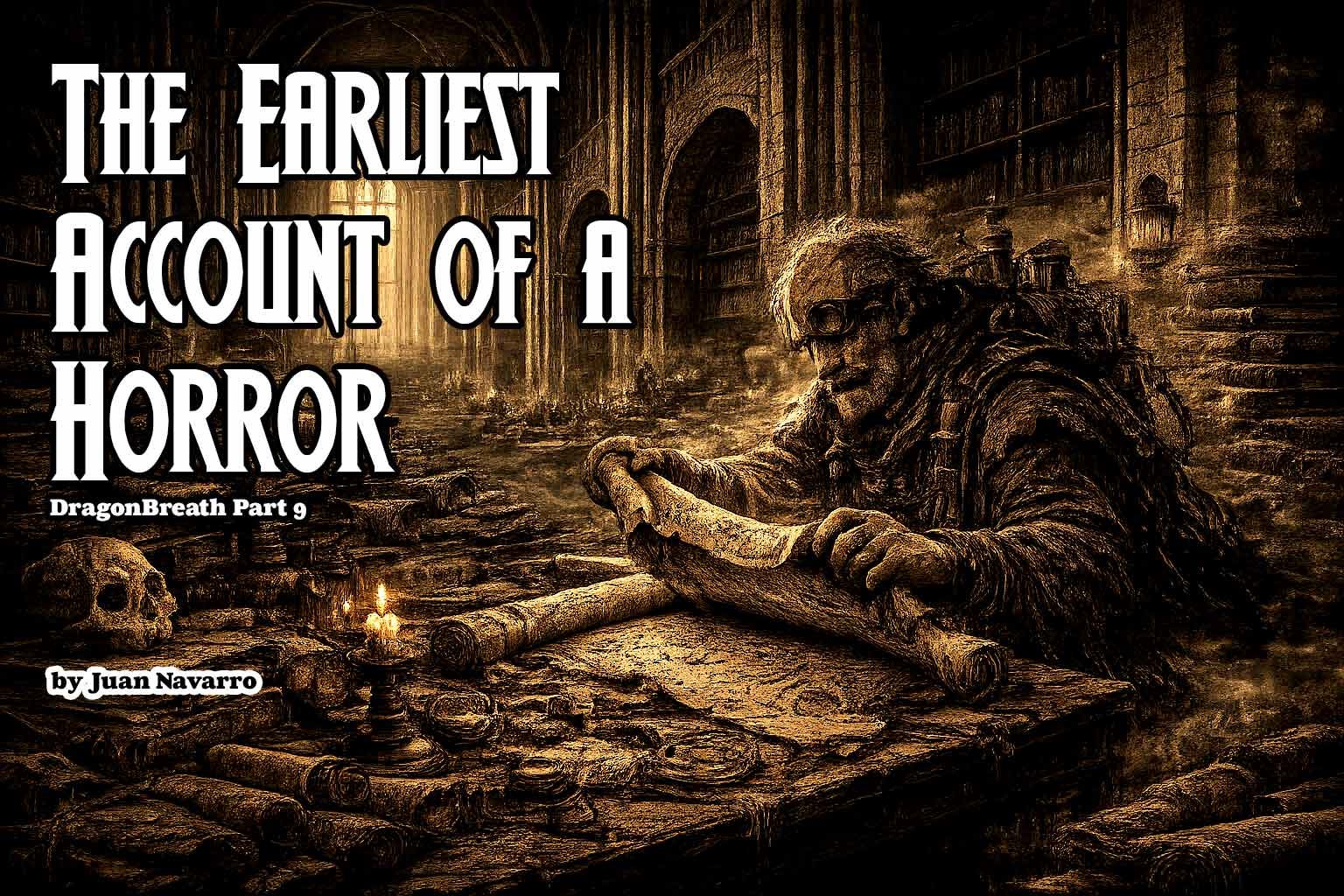
The Earliest Account of a Horror
Dragonbreath Part 9
A Borel Library Preservation Copy
Witnessed, translated, and re-inked by Arazib of the Grinning Coast
Morning broke with a brisk, electric chill that snapped the skin to attention, while sunlight seeped in slow gold, kindling warmth deep in the bones. Overhead, the sky unfurled in a blue so pure it unsettled, and to stand beneath it felt like stumbling into a blessing seldom granted.
No one inside the Library of Borel would know that.
Sunlight crept in as a ghost of itself, filtered through towering portrait windows made from the finest glass in all Essidarius. These windows were meant to keep time and decay at bay, holding the world’s ruin just beyond their reach.
They failed.
The Library breathed.
Ink. Tallow. Damp stone. The faint copper tang of clasps, burnished by hands long gone—or by those who once chased knowledge to their own undoing. The air pressed close, thick with the flavor of time left to sour and settle on the tongue.
The Library was a temple.
And a machine.
A machine built from people, meant to keep the dead from slipping away entirely—names, dates, lies, prayers. Most of its workings were dull. Repetitive. Suffocating in sameness. Yet the scholars, hunched like gold-seekers over a river, sifted through it all—shaking, rinsing, breaking it down—hoping for a single spark to catch the eye.
Gold.
Truth, sometimes.
Or something close enough to be dangerous.
Beyond the Library’s hush, Borel thundered—a living pulse that refused to be stilled. Harbor cranes groaned like iron beasts. Markets sang, spat, and quarreled. Banners cracked in the wind, bruising the sky with unruly color.
Some called Borel the rival of Oceanforge—the largest port in Essidarius—but that was a misunderstanding.
Oceanforge was where you did business. Borel was where you went to make deals.
This was a city built on substance, not show. In Lower Borel, forges, mills, and workshops crowded together, each fueling the next, all of it drawn uphill—into the college, into the ledgers, into the quiet calculus of power.
Rivals, people said.
But rivals are only siblings who refuse to share their toys.
Borel dealt with everyone.
Kings.
Pirates.
Navigators of the Violet Isles with compasses tattooed into their throats.
Goblin captains of the Grinning Coast, whose laughter came with knives.
Korixians from the ruined east, carrying philosophy like a sickness and lava-glass like treasure.
Even the Narrisians—ironbound, xenophobic, and insistent that they did not trade at all.
Which only meant they did it quietly.
Because Borel bowed to only one god.
The ledger.
And the Library—hidden behind marble halls and polite archives—was the city’s only act of faith in something that paid no interest at all.
Truth.
Or the shape of it.
That alone made Borel dangerous.
It was written into the place’s bones.
To be a scholar here was not to preach, but to dig. Knowledge hid beneath rot, rumor, and the rubble of lost worlds. You learned to sift sustenance from poison, gold from dross. In the stacks, old stories whispered warnings. A scribe named Kromus once pried open a forgotten codex and spent three nights convulsing, unable to remember his own name or speak in any tongue but the one written in its margins. Afterward, he returned to work with two fingers missing, sacrificed to the bindings by edict of the archivists, who insisted the book was safer that way. You learned which books paid in truth—and which demanded fingers, sleep, or your life as the price.
The Library sent its reach outward in all directions.
Paid notes. Sealed contracts. Quiet requests.
Bring back what can be brought back. A Navigator’s journal dragged from a wreck. A map stitched into skin. A sermon disguised as a recipe. A list of names no one was supposed to remember. The scholars of Borel gave this work a name. They called it—
The Regathering.
The world called Borel’s work an obsession.
Some, in quieter rooms, called it something else.
A refusal—a long, stubborn refusal to let the Horrors win twice.
Because the Horrors were fading.
Not dying—no one sane said that—but receding. Softening at the edges. Becoming stories told to keep children from wandering too far at night, instead of truths buried beneath cities and bone.
The Horrors had never been one thing. Some were insidious—whispers that unraveled the mind before the body ever fell. Others were gargantuan, reshaping land and sky as they moved. Some consumed without thought. Others were precise, patient, almost scholarly in their destruction. Chaos walked beside the method. Hunger beside design.
Some demanded worship.
Some simply watched.
In the Verren Hills, it was said the land itself shifted daily—paths folding, valleys turning inward, travelers vanishing not with screams but with quiet confusion, as if the world had politely misplaced them.
For nearly a thousand years, the Horrors ruled.
Not as kings. As conditions.
The world did not fight them. It endured them. Humanity retreated—underground, into stone, into whatever cracks could be carved or stolen. Some civilizations adapted. Some collapsed. Some became something else entirely.
And when the world finally clawed its way back into the light, it did what it always does.
It told stories.
Stories that softened the truth. Stories that made survival feel like a victory rather than an accident. No one agreed on when the first Horror appeared—only that it did. In daylight, some said, smiling. In dreams, said others, hungry. There were whispers that the Horrors were wounds in the world itself, torn open by something ancient and unresolved, leaking hunger and madness into reality. Others claimed a pact had been broken—something promised in the dark before history had language for it.
And some believed the worst of all: the Horrors had always been here. Sleeping beneath stone. Waiting for the world to forget their names. And the world was forgetting. It always did. Time sanded down terror into myth. Edges dulled. Costs erased. Warnings became folklore.
So Borel did what Borel always did when memory began to fail. It gathered. Not just stories. Not just names.
Everything.
Knowledge. Skills. Fragments of how the world had survived the first time.
The scholars called it The Regathering—a quiet, relentless effort to pull the scattered pieces of civilization back together before they were lost again. Out of necessity.
Because if the Horrors returned—and no one in Borel believed they wouldn’t—the world would need more than stories.
It would need to remember how to live through them.
Arazib’s cell was less a room and more a hollow carved out of patience and stone. The walls were rough where they had been cut, smoother where hands and years had worn them down. A single window, tall and narrow, leaned light into the space at an angle that shifted slowly across the day, as if time itself had to squeeze its way inside. Dust moved through that beam like a quiet thought.
His desk sat beneath it—broad, scarred, and uneven, made from old timber that had known other lives before becoming a scholar’s altar. Ink stains bloomed across its surface in dark constellations. Scratches marked where quills had pressed too hard, or knives had slipped while trimming them. Small objects gathered there in careful disorder: a chipped compass that no longer pointed true, a goblin coin pierced through with a nail, a shard of blackened lava-glass, a coil of thin copper wire, and a smooth river stone worn flat from years of turning in his hand while he thought.
Scrolls crowded everything. Some bound in twine, others stacked in leaning towers, a few half-unfurled like caught breaths. Shelves climbed the walls in uneven rows, holding more maps, fragments, sealed tubes, things labeled and things deliberately not.
Arazib himself sat within it all like a fixed point.
He was a man worn into his shape rather than grown into it. His skin held the deep tan of long sun once endured, now softened by years indoors. Faint scars crossed his forearms and wrists—old, pale, and deliberate. His shoulders were still strong, though age had settled a slight weight at his middle. Not softness, exactly—just the cost of surviving long enough to slow.
His face carried a quiet steadiness. Not kind, not harsh—focused. His eyes moved carefully, weighing, measuring, never wasting a glance. When he worked, the rest of the world thinned around him.
Here, in this narrow room of stone and light, Arazib did what he had learned to do best.
He endured.
And he made things last.
The hands of a man who had learned two kinds of labor:
The kind done with chains.
And the kind done with a quill.
Arazib had not always been called Arazib.
His first name had been stripped from him.
Removed with iron.
Used as a joke by goblins who liked watching human mouths struggle over their syllables.
He had served as a slave on the Grinning Coast, among merchants called Goblins of Skarhollow. Even now, flickers of those years could steal his breath or clench his fists when memory crept in: salt air, orders barked in wounding tongues, the certainty that hope belonged to other men. Sometimes memory alone made the world shrink. Still, he remembered. The old scars pressed deeper on some mornings, shaping the habits four freedomless years had carved. He kept to the edge of rooms, never turned his back to a closing door, and flinched at sudden laughter—especially from those with power. He reminded himself, quietly, that he was free now. But his old fears clung to him like a second skin, warping each interaction—a quick smile held too long, a polite word double-checked for offense. Sometimes, when speaking to fellow scholars, he wondered whether they noticed the pause in his voice when anyone mentioned chains or debts.
As if adding a noble suffix made chains respectable.
Skarhollow was a reef-torn strip of ports where ships disappeared, and men became inventory.
They traded spices.
Stolen idols.
Salt-cured flesh.
Along with laughter.
Goblins laughed often.
It made people nervous.
That laughter always sounded as if it wore teeth.
Arazib had spent twelve years carrying crates for men half his height, yet twice as cruel. Each day blurred into the next, marked by bruises and salt air. He learned how long a body could be worked before it became no more than a tool.
And he learned something unexpected: he learned to read. Educated slaves fetched a higher price. A literate slave could tally accounts, translate contracts, and decipher a Navigator’s journal before the Navigator’s blood cooled. And Arazib, in the world’s sharp-edged irony, loved the work that made him valuable. Words were the first things in his life that could not hurt him.
After several uneventful weeks of gathering and translating, everything changed. A Borel commission arrived—sealed, polite, expensive. A goblin captain wanted to impress a Borel patron. Arazib translated something valuable. The patron bought the document. Then, quietly, bought the translator.
In Borel, even freedom came with a receipt.
Arazib did not mind.
He was older now—not ancient, but weathered. His spine still remembered the weight of chains, and he moved with a quiet vigilance, always braced for trouble. Yet in the Library, violence kept to its boundaries, and Arazib cherished those limits. He loved the scratch of quills, the careful labor of coaxing fragile things to endure. A scribe. A preserver. A man who could face a dying story and decide, as unyielding as stone, that today it would survive. Over time, that purpose sharpened into obsession.
Arazib’s purpose—the relentless engine beneath every quiet moment—fixed itself on the Horrors. Not because they frightened him, but because he could not ignore their mark on his world. For Arazib, memory was more than record-keeping or hoarding brittle facts. Each act of remembrance was a rebellion. In a world desperate to forget its darkest hours, he clung to memory as a shield against helplessness and slow erasure. To remember was to resist being shaped by others’ lies or by silence itself. It was, for him, the only way to reclaim the fragments of himself that chains and terror had tried to steal. Without memory, he believed, freedom was only another kind of illusion.
Though they did—because they explained too much of the world. The Horrors were the hinge on which everything turned, the moment history stopped being a line and shattered into glass. Nine hundred and sixty-six years ago—give or take a decade, depending on whose calendar you trusted—the world cracked. Kingdoms vanished. People disappeared. Maps became jokes. And then, slowly, survivors clawed their way back into the sunlight and began weaving new lies to make sense of what remained.
Arazib hunted for the oldest records—the instant the world shifted from merely dangerous to something altogether stranger. Most scholars shunned those accounts. They were tangled. Contradictory. Embarrassing in the way truth so often is. But Arazib, who had paid the price of ignorance in chains, prized truth, however it scorched. Discomfort, he knew, was rarely a barrier. More often, it was the truth itself, waiting at the threshold.
So when another donation arrived from a collapsed noble estate, Arazib did what he always did. He dug in. He sorted. He listened—not with his ears, but with that quiet instinct honed over years—for the moment a scrap of paper might whisper: I matter.
Time slid past in the soft rustle of parchment, in the dry whisper of fibers brushing together, in the slow dance of dust through angled light. Hours vanished unnoticed, the world shrinking to ink, texture, and the gravity of forgotten things—until, at last, he found it.
A scroll wrapped in oilcloth. The cord fell apart at his touch, brittle with age. The seal was unfamiliar—not Borel, not Oceanforge, not Korixian, not Narissian. A mountain mark. A laughing face with a hammer in its mouth.
Karabek.
Arazib went still. His breath caught, sharp and sudden, as if he had wandered too close to an invisible brink. The Scriptorium’s silence thickened, pressing in. His hands gripped the scroll, knuckles whitening. This was no relic dulled by centuries. This was something else—a key, perhaps, to a history the world had hidden on purpose. A tremor ran through him, equal parts awe and dread. For a heartbeat, he felt observed—not by living eyes, but by the weight of something that had waited too long to be recalled.
Karabek survived now only in footnotes. A mountain kingdom. Pre-Horror. Stubborn. Devout. Unusually intact. A place scholars spoke of with the careful distance reserved for things not fully understood. A kingdom rumored to have met the first Horror—and lived long enough to record it.
He opened the scroll slowly, reverently, as if unsheathing a blade.
The first line struck like a blow:
ON THE DAY THE MOUNTAINS CRIED
THE WORLD LEARNED IT COULD SUFFOCATE.
Arazib’s fingers clenched, but he did not pause. He dipped his quill and began to copy. The text was not a story—it was something harsher. It was a record, a witness account of a Horror, rewritten by many hands, each trying to smooth its terror into something history could bear. But fear does not smooth away. It lingers. It seeps between the lines and pools in the spaces between words. Fear has its own grammar—and Arazib could hear it.
From the Karabekian Cliff Tribe, attributed to Brother-Historian Gavnus of the Laughing Hammer Shrine:
The morning was clear.
That is how the world tricks you.
Karabek’s cliffs rose like shattered teeth along the spine of the continent, sharp against the sky. Below them lay forests, goat paths, and villages carved directly into the stone—homes shaped by necessity and stubborn will.
Karabek had always been a hard place, and it made hard people. They mined. They hunted. They climbed. They drank strong ale and laughed louder than thunder. Their god was Magnus—a god not of quiet prayer, but of raised mugs and bruised knuckles.
Magnus was not a god you begged.
He was a god you toasted.
His shrines were filled with cracked mugs and broken helmets. His priests preached with fists and blessed with laughter that struck like blows. Magnus believed the world was cruel—but it could be out-laughed.
They believed, foolishly, that mountains were forever.
The fog proved otherwise.
It began as a breath from the ground—not mist from the valleys, not cloud from the sky, but something rising from cracks and fissures, as if the earth itself had exhaled what it had held too long. At first, the shepherds thought it a vent, a harmless release of heat and gas. Then the goats began to choke, and the birds fell from the air. The fog moved against the wind, and the laughter stopped. They named it later.
Todesnebel.
Death Fog.
A wandering weather system that fed on breath—not poison, not smoke, but something worse. Something that did not simply kill.
Something that devoured the part of you that still wanted to live.
When it reached the first village, the people ran outside, thinking it was fire. They ran uphill.
The fog followed.
It poured into mouths, into lungs, into the quiet places of the body, filling them with something heavy and final. The dying made no sound—they simply… stopped. And the mountains learned a new kind of silence, one that spread.
Karabek survived those first hours only because of the wind. But the fog learned. It climbed, it flowed, it hunted. And when the priests of Magnus finally understood, they gave it the name the world would remember: Horror.
Arazib checked the dates, cross-referencing margins, seals, and the style of the hand, his mind moving faster than his quill. The realization settled in slowly, then all at once—this was it. The first recorded emergence. Not a beast. Not a demon. Something else entirely. A thing that twisted the world’s own air into a weapon.
His quill slowed, not from fatigue, but from a single line that caught and held him.
Stone does not move quickly.
But it moves.
He stared down at the ink as it settled into the page, dark and certain. The word Todesnebel pressed on his memory. He had heard it before—half-dismissed, buried in a Korixian argument, two scholars shouting over tea about whether a fog could think. At the time, it had sounded like a metaphor.
Now, it felt like a warning.
One insisted the fog had intent, a slow, creeping will that learned and hunted. The other called it madness, swearing it was only blind chance. Their argument made the air heavy with possibility.
He had assumed it was a metaphor.
Now he was not so sure.
Later notes crowded the margins, written in different hands across different centuries. Some claimed the fog was the breath of a buried god; others said it punished laughter or was a natural cleansing. Arazib noted that the last line carried the cold confidence of a Narissian scholar. Still others whispered that the fog spoke in dreams, offering bargains for air.
Arazib copied everything, his quill moving with steady precision, but his thoughts snagged on a single detail—one repeated again and again. It came from the north of Karabek, a place described only as ice and desolation, a direction the text returned to with quiet insistence. The phrasing lingered with him, unsettling, as if it pointed not just to a place, but to something beneath it—as if the world itself had opened its mouth.
The Library around him breathed in silence. Quills scratched. Pages turned. Somewhere, a junior scholar coughed and hurried an apology to the air. Arazib gazed upward, listening to the hush between sounds. Borel’s patrons believed this place held danger at bay, that knowledge, once gathered, could be locked away. But Arazib knew better. Libraries did not keep danger out. They kept it named. And naming, he understood, was only half a shield. Names could mark the shape of fear, trace its boundaries, but they could not hold it in place. To truly keep danger at bay, it required vigilance, remembrance, and the courage to act upon knowledge—lest names become little more than gravestones for forgotten truths.
The final lines of the Karabek ledger read less like history and more like a prayer: We were wrong to think the world was solid. We were wrong to think the air belonged to us. We were wrong to laugh at the quiet. The mountains cried—not with water, but with breath—and the world learned it could be taken without a hand laid upon it. Arazib let the words settle, heavy as stone, before setting his quill aside.
For a moment, he just listened. No harbor wind. No street noise. Only the slow breathing of scholars and the dim hush of lamps—and beneath it, something else. A rhythm. Tok. Tok. Tok. Like a distant machine quietly counting. He shook it off, cataloged the scroll, then added a second note—not for the Library, but for himself: Identify who profits from forgetting. Because the Horrors were fading, and the world, like a tired drunk, was already trying to laugh them away. Arazib leaned back and let himself think a dangerous thought—maybe the Horrors were not vanishing. Maybe they were simply… learning new shapes. And somewhere under the stone, the earth waited, holding its breath, ready to exhale again.


