


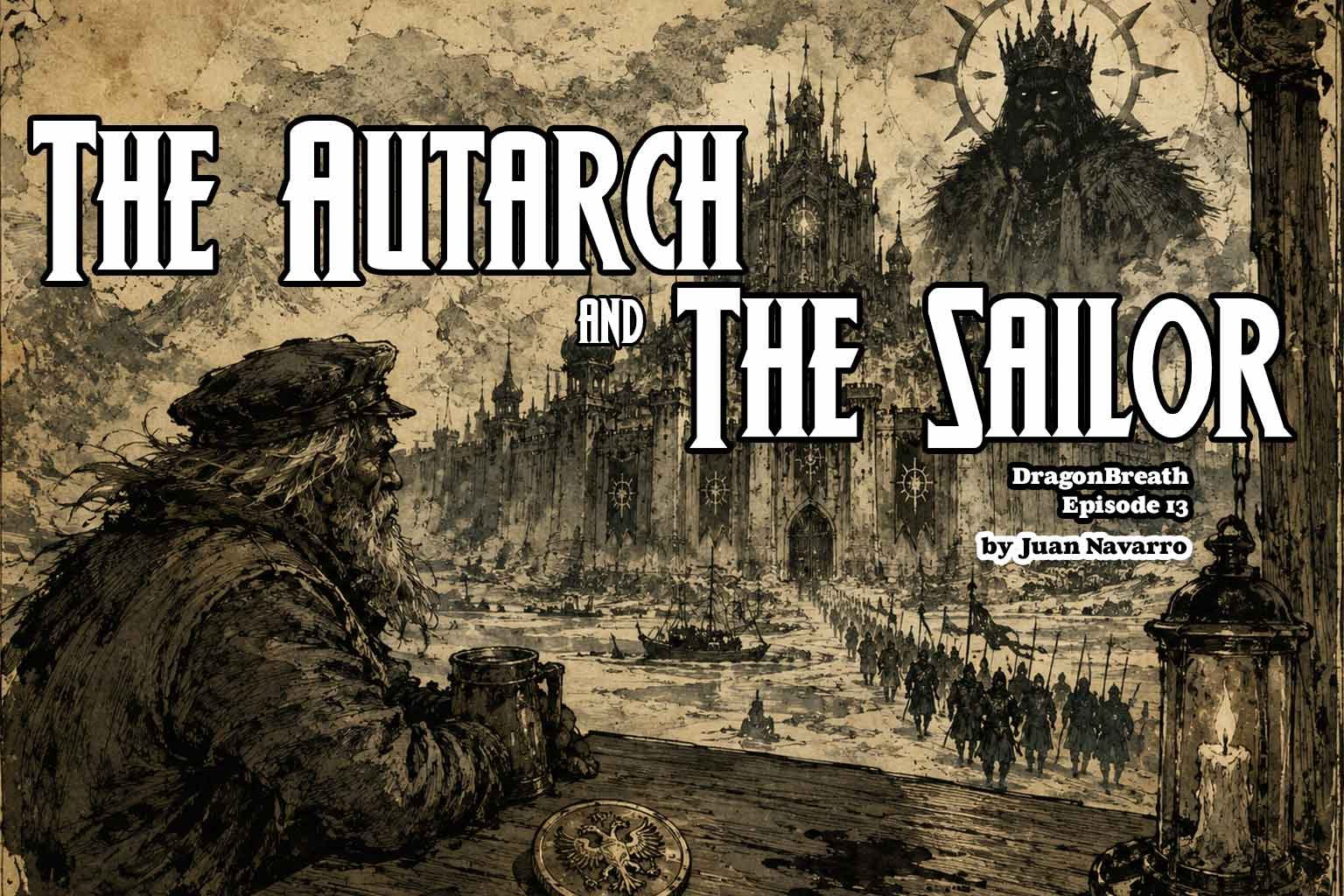
A copper for your thoughts, or would I get change coming?
The old man claimed the sea remembered everything, and he said it with the bitter conviction of someone who’d tried to outshout the tide and ended up coughing up saltwater and pride.
Not the way sailors get poetic after their third bottle and a lifetime of bad decisions. He meant it with the kind of seriousness that makes you check your pockets for knives. The sea, he said, carried memory the way blood carries plague—always lurking, always ready to ruin your day. If you listened to the hulls groaning in Oceanforge harbor, or the black water north of Karabek, you could hear the world itself trying to drown out the memory of Narrisia, and failing.
Most ignored him. That was tradition at the Vomiting Dragon, right alongside watered ale, sticky floors, and the kind of decisions that make you wish you’d been born a fish.
The tavern squatted by the lower piers, where steam tangled with salt and the gutters ran red every time the slaughter barges limped in from the eastern fisheries. The place leaned left, like a drunk who’d lost a bet with gravity. Pipes hissed overhead. Blue condensation dripped from copper veins and splashed into mugs that hadn’t seen coin since the last king died. Upstairs, a woman laughed as if she were losing a knife fight. Below the floorboards, something scratched with the patience of a debtor waiting for the gods to forget his name.
The old man had staked out a corner beneath a mural of a dragon vomiting fire onto a parade of tax collectors. He looked like he’d been carved out of stubbornness, bad luck, and the kind of spite that keeps you alive through three wars and a marriage.
One of his eyes was clouded, blind from age or maybe just from seeing too much. His fingers were crooked from old breaks, his beard stained yellow by pipe smoke and years of salt wind. He wore a wool coat big enough to hide a goat, or a small crime. He smelled of salt, mildew, and an oil that clung like a curse. One boot clanked from iron plates hammered into the sole, and his accent hacked through the Common Tongue as it owed him money.
“Narrisia,” he rasped, staring into his cup, “was not born wrong.”
Nobody answered.
A few patrons glanced over, then went back to their cards or drinks. In Oceanforge, you learned quickly that listening too closely to old sailors usually ended in religion, stabbing, or both if you were unlucky.
The sailor continued anyway.
“We were proud once. Cold people, yes. Hard people. But proud.” He scratched at his beard. “The valleys of Narrisia were dead to magic long before the Horrors came. That is truth. Ask any scholar stupid enough to walk there.”
The merchant nearby barked, “Why would magic steer clear of your land, old man?”
The sailor slowly looked at him.
“Because something already lived there.”
That earned him a few more glances, the kind you give a man who might be about to start a fire or a sermon.
Not many. But enough.
Outside, thunder rolled over Oceanforge harbor. Rain tapped at the warped glass like a beggar with cold fingers. Somewhere deeper in the tavern, someone started up a fiddle tune that sounded like a funeral trying to remember how to dance.
The sailor drank.
“You know Bleed Stone?” he asked.
A dockworker nodded cautiously. “Warp stone. Weirdstone. Heard the names.”
The old sailor spat onto the floorboards.
“No. Those are wrong names given by southern fools. Warp stone bends magic. Bleed Stone kills it.”
He tapped the table with one thick finger.
“In Narrisia, magic dies.”
He spoke the words quietly, but something about them made the nearby lantern flicker.
Not everywhere. But enough. Whole valleys where spells unravel in your mouth. Places where druids become blind. Places where enchanted blades rust in their sheaths. The mountains themselves are threaded with the stone, veins thicker than rivers. Some say they were placed there by the gods to cage something beneath the world. Others whisper the Bleed Stone is older than the land itself— a wound from when the sky broke, and the world bled. The oldest scholars argue it is the remains of a dead star that fell in ancient ages. It poisoned the earth and sapped magic wherever its shadow reached.
He smiled the way a man does when he’s run out of better options and is about to try his luck with the worst one.
“Others say they are the bones of that thing.”
The dockworker swallowed.
The sailor leaned back slowly.
“You foreigners think Narrisia hates magic because we are cruel. Because we are frightened peasants wrapped in iron and snow.” He coughed wetly into his fist. “No. We hate magic because we remember what it does when left alone.”
A serving girl passed by carrying drinks. She slowed slightly to listen.
The sailor noticed.
Old men lived on stories the way drunks lived on cheap ale and the kind of bad decisions that get you banned from three ports.
“The Autarch understood this better than anyone.”
Now the room shifted.
Even drunks knew that title.
The God-Autarch of Narrisia. The immortal ruler in the north. Divine tyrant. Prophet. Monster. Depending on who told the story.
The sailor lowered his voice.
“The Last Emperor.”
A silence settled over the nearby tables.
He smiled like a man chewing on a mouthful of nails and pretending it was steak.
“Though perhaps ‘last’ is the wrong word.”
Rain hammered harder outside.
“I was born in Kharov Vale,” he said. “Before the purges reached the coast. Before the smoke towers. Before the machine legions marched west.”
His eyes wandered off to some place only ghosts, old regrets, and tax collectors could find.
“My father built anchors. My mother stitched winter sails. We prayed to the old saints then. Sea saints. Storm saints. Tiny gods with tiny powers.” He chuckled softly. “Narrisians distrust large gods. They ask too much.”
A man near the bar muttered, “Except your emperor.”
The sailor nodded slowly.
“Yes. Except him.”
He worked his scarred hands together like he was trying to coax a fire from old bones and older grudges.
“The old stories say the Autarch was not born. He arrived.”
Nobody interrupted now.
They say he walked out of the northern ice during the Years of Ash, when the Horrors still roamed openly, and the world burned itself alive every season. Some claimed he was a prophet sent by Balo. Others claimed he was a king from before history. Some said he was a Horror wearing human skin. He paused, eyes narrowing. There are older tales too. Strange things seen in his shadow. Wolves howled in daylight whenever he passed. Snow fell black for three nights after his arrival in Voromir. Once, a priestess swore she looked into his eyes and saw stars moving beneath ice. No one who served him ever agreed on the sound of his voice.
The fiddler upstairs stopped playing.
The silence deepened.
The sailor’s cloudy eye drifted toward the ceiling as though remembering something he wished he could forget.
“He united Narrisia in thirteen winters. Do you understand what that means?”
Nobody answered.
“Thirteen winters,” he repeated. “Our clans once killed each other over sheep paths and fishing rights. We buried knives with our children so they would be armed in the afterlife. Yet this man walked into the valleys and made us kneel.”
His voice became softer.
And the frightening thing was, people wanted to. Like sheep lining up for the butcher, smiling all the way.
The serving girl now remained frozen beside the table.
“He spoke little,” the sailor continued. “Never shouted. Never threatened. He simply looked at men, and they felt ashamed for disappointing him.”
A laugh slipped out, low and sharp as a broken bottle in a back alley brawl.
“My grandfather saw him once in the city of Voromir. Said he walked through snowfall without leaving footprints.”
A drunk at the bar scoffed nervously. “Old nonsense.”
The sailor ignored him.
“He began the Purity Wars shortly after. Claimed the Horrors were not dead. Claimed they hid inside magic itself. Claimed every sorcerer was a doorway waiting to open.”
He drank again.
“And perhaps he was right.”
The room shifted uneasily.
“In the north,” the sailor said, “there are ruins older than memory. Black towers buried beneath mountains. Places where even wolves refuse to howl.” His voice cracked slightly. “The Autarch found one beneath the city of Dresk.”
Now even the tavern keeper had stopped wiping mugs.
The sailor leaned forward.
“They uncovered a chamber made of stone that bled when struck.”
Nobody moved.
“At its center,” he whispered, “was something alive.”
Lightning flashed outside.
For a heartbeat, the old man’s face looked like it was trying to remember how to be a skull, and almost succeeding.
“They called it a bound Horror.”
Someone laughed nervously.
The sailor did not.
It had no shape. That was the problem. One man saw a mountain of mouths. Another saw his dead wife. Another saw a field of screaming horses stitched together by human hands. The men who survived the sight did not stay themselves for long. Some could not sleep without waking to screams. Others spoke nonsense and clawed at their own faces until blood ran. Wherever its chamber lay open, nothing grew for miles. Water turned brackish. The air thickened, as if weighed down by invisible hands. It was as if the land itself tried to forget what it witnessed, but could not.
The serving girl quietly set the drinks down and sat beside the dockworker without realizing she had done so.
“The emperor ordered it contained,” the sailor said. “Not killed. Bound.”
He stared into his cup.
“That was the beginning of Narrisia as you know it.”
The dockworker frowned. “Bound how?”
The sailor smiled faintly.
“With men.”
A coldness passed through the room.
The Bleed Stone beneath Narrisia suppressed magic. The Autarch believed he could use it as chains. Massive engines were built beneath the mountains—vast iron constructs with spines of copper and wheels that crushed bone into dust. They fed on blood and sorrow, belching steam through pipes that throbbed like the veins of some buried giant. Entire cities were hollowed into laboratories and prisons. His voice became distant again. Priests fed themselves into the machines willingly. Sorcerers were cut apart while still breathing so their deaths could strengthen the bindings.
The merchant near the fire muttered, “Gods preserve us.”
The sailor laughed harshly.
“No gods entered those valleys.”
Rain battered the windows now.
“They say the emperor descended beneath Dresk himself during the final binding. Three thousand soldiers marched with him.” His voice grew quieter with every sentence. “Only he returned.”
Someone whispered, “What did he see?”
The sailor looked up slowly.
“Himself.”
Nobody spoke.
“He emerged changed. Taller. Stronger. Colder.” The sailor rubbed at his bad eye. “After that, he no longer aged. Priests began calling him divine. Whole armies worshipped him as a living god.”
He leaned back.
“And perhaps he was.”
A long silence followed.
The old sailor stared into the dark tavern while thunder rolled over Oceanforge.
“Then came the purges.”
His voice had gone flat now.
“Magic outlawed. Elves butchered. Witches burned alive inside iron bells. Entire villages marched into mines to dig Bleed Stone until their teeth fell out.”
The dockworker asked quietly, “And you?”
The sailor took a long breath.
“I served the navy.”
His lips twisted like he’d bitten into something rotten and realized it was his own words.
“We hunted refugees. Smugglers. Mages fleeing west.” He stared at his hands again. “I told myself we protected the world.”
Another pause.
“Then I saw the emperor.”
The room leaned closer without meaning to.
“It was during the Siege of Korvath Port. Rebels had seized a fortress on the cliffs. Mages among them. We expected artillery.”
His breathing slowed.
“The Autarch arrived alone.”
The sailor’s remaining eye had gone distant again.
“He walked through cannon fire.”
Nobody laughed now.
“The rebel sorcerers unleashed everything they had. Firestorms. Bone curses. Lightning. The sky itself split open.” His voice shook slightly. “And none of it touched him.”
The dockworker whispered, “Bleed Stone?”
The sailor nodded once.
“No magic survived near him.”
He swallowed hard.
“Then he raised his hand.”
The tavern had gone utterly silent.
“And the mages...” The sailor’s jaw tightened. “They forgot how to cast.”
Even the thunder outside seemed quieter.
“One woman screamed because she could no longer remember her own name.” He rubbed his forehead slowly. “Another clawed her eyes out trying to find her spells.”
The merchant crossed himself instinctively.
The sailor continued.
“The rebels surrendered within the hour. The emperor ordered every one of them sealed alive inside the fortress walls.”
He finished his drink.
“That was the day I deserted.”
The dockworker whispered, “You fled Narrisia?”
The sailor nodded.
Took a fishing boat west through storm waters. Lost two fingers to ice, my son to fever before we limped into Oceanforge. Lost my wife somewhere before that, but that’s another story and a worse one.
Nobody had the right words, or the wrong ones.
The old man sagged, as if the years had finally caught up, handed him the bill, and waited for a tip.
“The Autarch still rules,” he murmured. He hesitated, eyes flickering as though chasing old rumors through the smoke. “They say he has not aged in fifty years. Some claim he is a shadow behind his own eyes. Or something wearing him does.”
A voice came from the darkness nearby.
“You believe he bound the Horror?”
The sailor looked up.
A man sat alone at a nearby table that had been empty moments before.
Wide-brimmed hat.
Dark coat damp from rain.
A pipe smoldered quietly between gloved fingers.
Nobody had seen him enter.
The sailor stared.
The man’s face remained mostly hidden beneath the hat brim.
“What I believe,” the sailor said carefully, “does not matter.”
The stranger smoked silently.
“Yet you told the story anyway.”
The sailor’s hands tightened around the mug.
“I am old.”
“That has never stopped fear before.”
Something about the man’s voice made the air feel smaller.
The sailor studied him carefully now.
Not drunk.
Not sailor.
Not dockworker.
Too still.
Too calm.
“Are you asking if the stories are true?” the sailor asked.
The stranger nodded once.
The old sailor took a long breath.
“I think the emperor tried to chain a Horror.” He swallowed. “And I think the Horror chained him back.”
The pipe ember glowed brighter.
Around them the tavern noise slowly returned, though quieter now. Dice rolled. Someone laughed upstairs. A drunk collapsed against the bar.
Life, as always, pretending the abyss was just another neighbor who borrowed your tools and never gave them back.
The stranger reached into his coat and placed a copper coin onto the table.
Heavy.
Narrisian.
The old imperial seal gleamed in the lanternlight.
The sailor froze.
He had not seen one in decades.
“You know what they say in Narrisia?” the stranger asked softly.
The sailor said nothing.
“The dead should remain useful.”
The man stood.
For a brief moment, the sailor noticed how tall he was.
Not giant tall.
Wrong tall.
Like his proportions had been remembered imperfectly.
The stranger stepped beside the table casually, as though preparing to leave.
Then he moved.
Fast.
One gloved hand covered the sailor’s mouth while the other drove a thin black blade upward beneath the ribs.
Precise.
Practiced.
The sailor jerked once.
No scream escaped him.
The blade slid perfectly between organs. A killing strike designed not for pain, but silence.
The old man’s remaining eye widened.
The stranger leaned close enough for only him to hear.
“Some things,” he said quietly in Narrisian, “are better as myth than truth.”
The sailor tried to breathe.
Couldn’t.
The blade twisted once.
Gently.
Then the stranger lowered him back into the chair like a sleeping drunk.
Nobody noticed.
Or if they did, they preferred not to.
That too was Oceanforge: a city where the dead kept their seats warm, and the living pretended not to notice.
The man removed the blade, wiped it clean with a cloth, and placed the pipe back between his teeth.
The copper coin remained on the table beside the sailor’s stiffening hand.
Outside, rain swallowed the streets.
The stranger paused briefly at the tavern door.
For just an instant, lightning illuminated his face beneath the brim.
Pale.
Ancient.
And his eyes—
Not human.
Then he stepped into the storm and vanished into Oceanforge night, leaving the dead sailor alone with his story and the terrible possibility that every word of it had been true.