


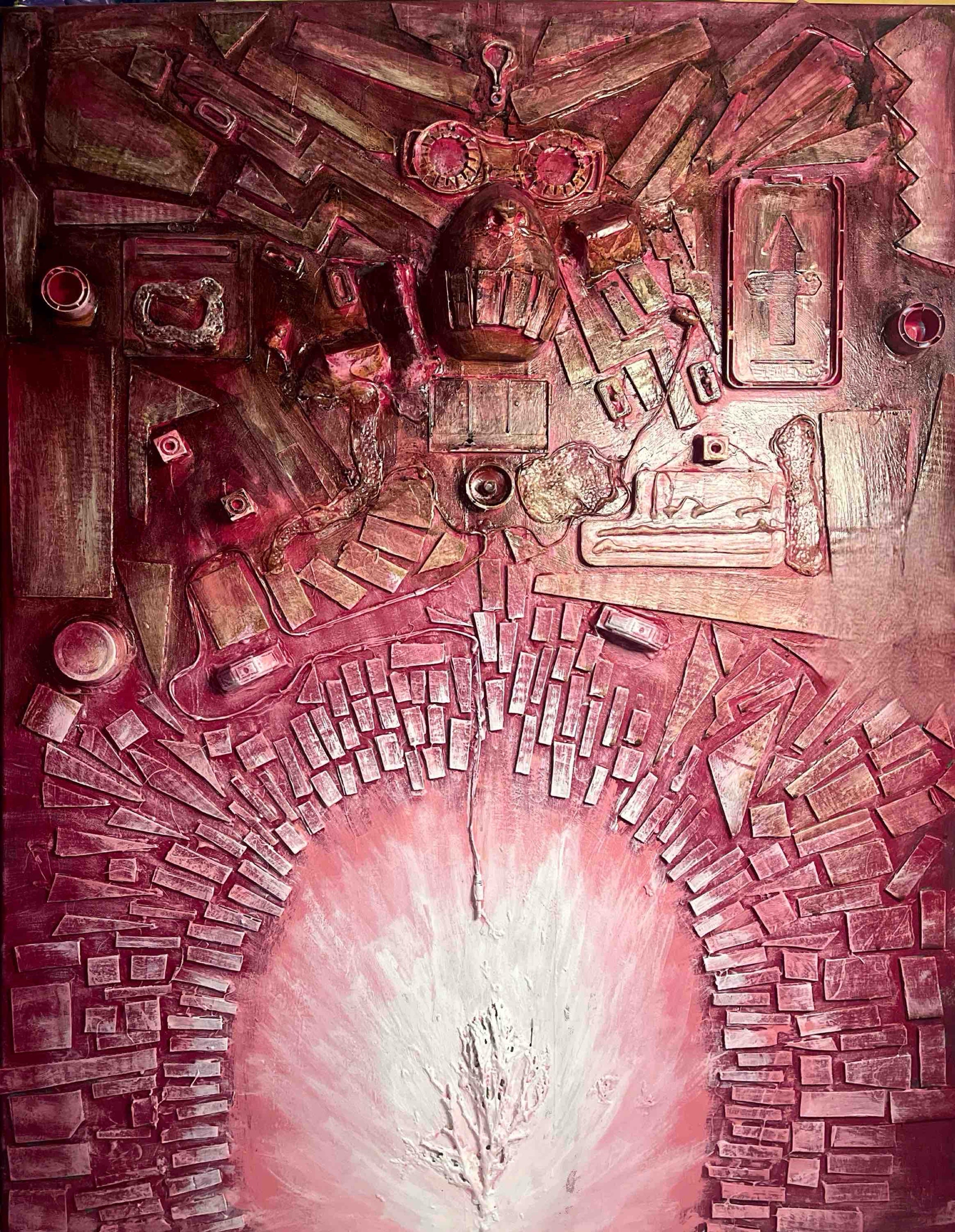
CALCINATION No. 1 takes its name from the alchemical process of using intense heat to reduce matter to its essential form. Historically, calcination was both a physical process and a metaphor for transformation: what must be burned away for something new to emerge?
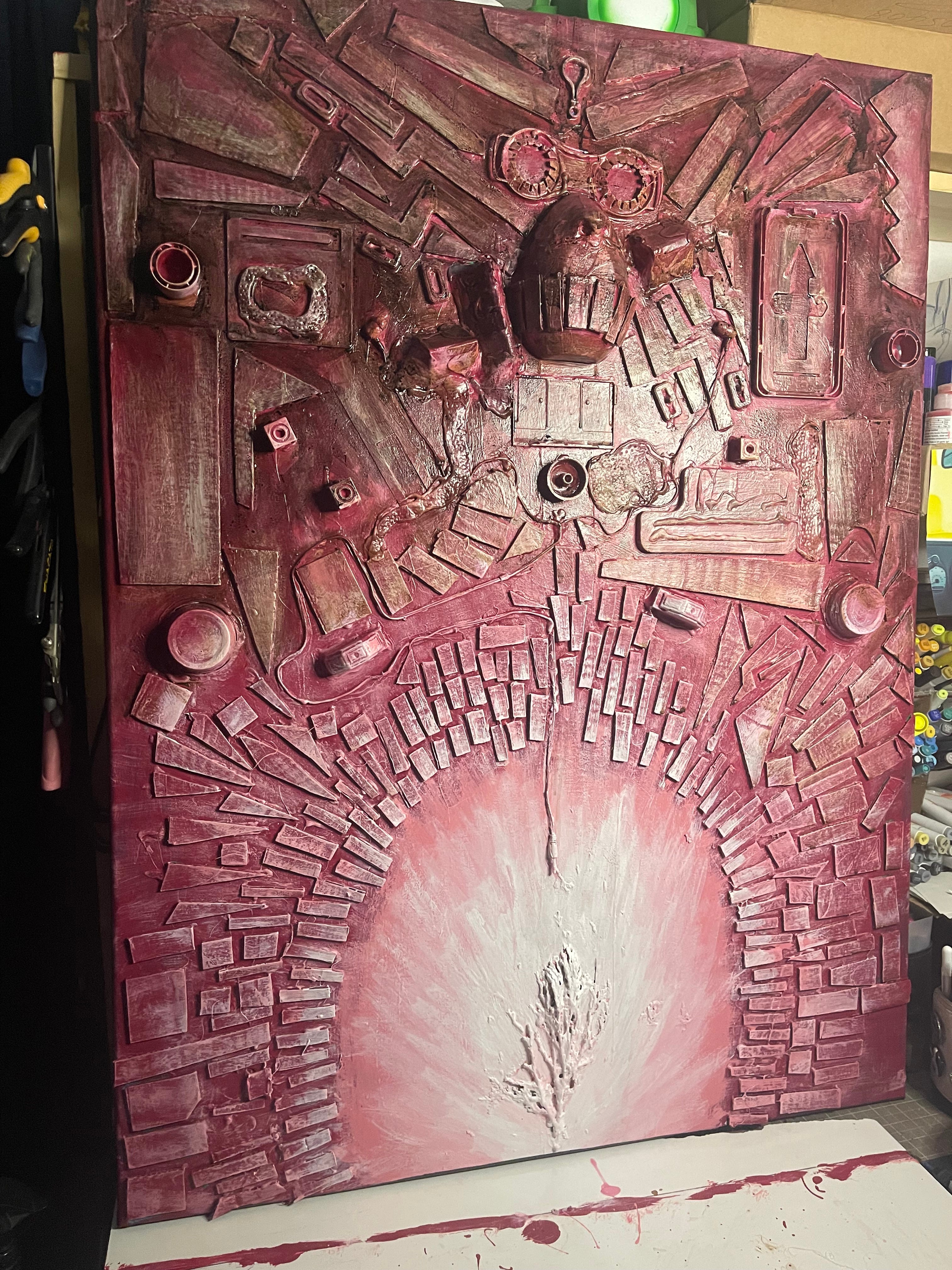
The painting considers that question on both a personal and collective scale. Human growth is rarely clean. As individuals, societies, and a species, we build ourselves from accumulated experience—our tools, failures, memories, technologies, beliefs, and discarded things. The found objects embedded throughout the work become artifacts of that accumulation, forming an almost archaeological landscape of human endeavor.


At the bottom of the painting, actual leaves are entombed beneath layers of acrylic. They represent the organic root beneath everything we construct: nature, mortality, and the living world from which human invention ultimately emerges. From them rises an intense white-and-pink light—fire as destruction, purification, knowledge, ambition, and the internal force that compels us to create.
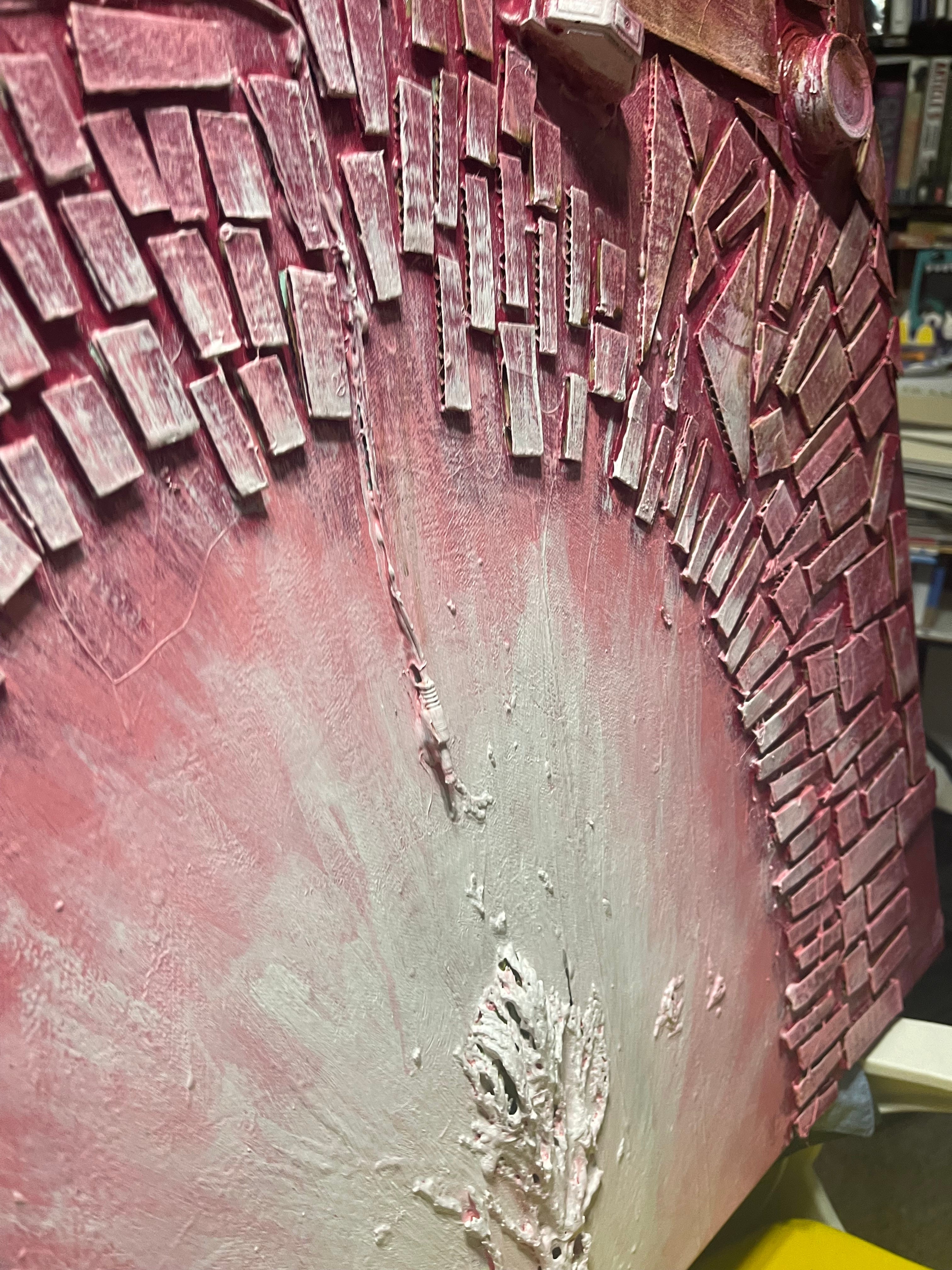
Above it hangs a dense mass of objects and forms. It can resemble machinery, architecture, debris, a technological altar, or even a hazard sign. Yet I do not necessarily see this darkness as something descending upon the light. It may instead be the shadow cast by that light—the complicated consequences of our own desire to progress.
Artificial intelligence has made that question increasingly immediate. Are we opening another frontier of human creativity and knowledge, or constructing something that ultimately narrows the very horizons we hope to expand?


Visually, the work draws from the monumental social storytelling of the Mexican Muralists while filtering those impulses through the psychologically charged forms of Philip Guston and the raw, graphic energy I find in artists such as Ashley Wood and Sam Kieth. Painting, drawing, collage, assemblage, and found material are allowed to collide rather than resolve neatly.
CALCINATION No. 1 does not attempt to answer whether the fire of human progress saves or consumes us. It asks what remains after the burning—and whether we recognize ourselves in what survives.
Hopefully, CALCINATION No. 1 will make its public debut at the 77th Annual Sun Bowl Art Exhibit at El Paso’s International Museum of Art. What began in 1949 as the Sun Carnival Art Exhibit has become one of the longest-running juried art exhibitions in the American Southwest and a showcase for the incredible range of artists working in our region.
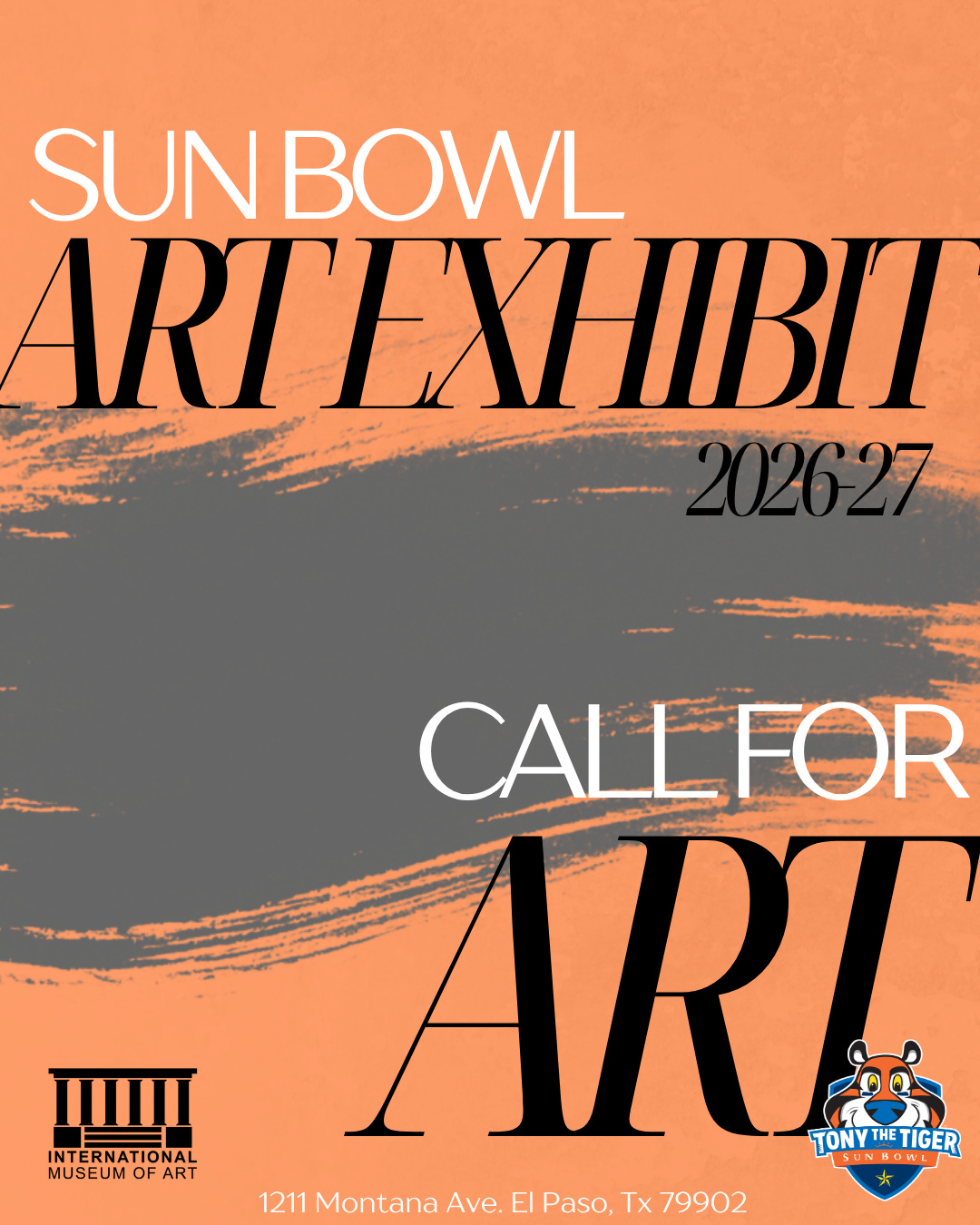
The exhibition has no prescribed theme—artists are simply asked to submit work that best expresses their practice, creativity, and vision. For me, CALCINATION No. 1 feels like exactly that: a culmination of the painting, drawing, assemblage, comics, found-object work, and general creative chaos that have followed me throughout my career.
So, into the fire it goes.
We’ll see what survives.