


Once, the world crawled down into the dark and slammed the door behind it.
Not the way the soft-palmed scholars in Borel’s candlelit mausoleums would have you believe, scribbling their metaphors and poetry until the ink seeps into their bones. No, the world went under because there was nowhere left to run. The Dwarves were already waiting, their stone wombs yawning open, strongholds braced for the end of days.
Before the Horrors, the Dwarves of Essidarius weren’t kings, weren’t saviors, and if you called one a saint, you’d get a laugh and a fist in the teeth for your trouble. They were builders, delvers, hoarders of secrets too old to remember and too stubborn to die. Their kingdoms wormed through the continent’s bones—cathedral halls echoing with old songs, cities dangling from the bellies of caverns, whole civilizations thrumming beneath stone and the weight of everything above. To Dwaves, holding a grudge is an endurance sport: the never-forgive and, worse, never-forget.
They traded when it suited them. Closed their gates when it did not.
Up top, the world spun itself dizzy—kingdoms sprouting and collapsing like drunks at a festival, elves weaving their silent empires through the green and the fog, halflings slipping between the cracks of everyone else’s stories. But down below? Down below was slow. Down below was a stone. Down below was forever, or as close as mortals ever get.
Until the sky broke.
No one agrees on what the Horrors were—fire given thought, tides that walked, shadows that devoured memory, bone-things that sang in languages older than the world itself. They came from somewhere—deep or far or beyond—and they did not ask permission to exist. They simply did. Scholars spin tales as endlessly as the wind: that the Horrors were the afterbirth of a dying god, or that they crawled up from cracks left by mortals digging too deep, or that the nightmares of the world itself took shape, hungry for revenge. Some whisper the Dwarves themselves woke them with a song best left unsung, but ask ten people and you’ll get ten different shivers. And the surface world, as all things do when faced with extinction, ran: to the mountains, to the forests, to the doors beneath the earth. Some Dwarven kingdoms opened their gates. Some did not. Some opened them too late. And some… only partway. History remembers the stone that held; it does not always remember what was left outside. But people do. They remember the pounding on the gates, the screams that stopped, the screams, and the silence that followed.
When the Horrors finally slunk away—if you can call it that—the world crawled out blinking into a landscape that looked like it had lost a knife fight in a back alley. Cities gone. Seas wandered off. Forests burned or, worse, started thinking for themselves. Whole cultures wiped away like chalk from a gaming table.
And beneath it all, the Dwarven kingdoms remained—some intact, some corrupted, some sealed forever, their gates never opened again. The surface world rebuilt, slow as a hangover and crooked as a politician’s promise, and always, always with teeth. As the world stitched itself back together, resentment took root in the cracks—quiet at first, stubborn as weeds—because while everyone had suffered, the Dwarves had endured. They were praised, honored, called the Bastions of the World, and behind closed doors—in taverns, in camps, in fields far from stone walls—they were called cowards, gatekeepers, hoarders of safety, keepers of life for some and not for others. The Dwarves heard it; of course they did. Stone remembers every word whispered to it, and it remembers for a very long time. They answered the only way they knew how: they built higher, closed tighter, trusted less. And so the divide hardened. Dwarves became both revered and reviled—welcomed in times of need, resented in times of peace. Their halls still held wealth, knowledge, weapons, and shelter unmatched by any surface kingdom, but they also held something else: memory. And memory, unlike stone, does not stay still.
Gaf knew all of this.
He had lived it.
He was twenty-six when the gates closed.
A boy by Dwarven measure, old enough to hold a hammer, not old enough to question the hand that placed it there, he remembered the orders, the arguments, the pounding, and most of all the sound that followed. Not the screams, not the chaos, but the silence after. One day, the gates opened again, and the world beyond was still there—just less of it. Gaf left not long after, not in protest, not in defiance, but because the weight of that silence planted something restless in him, a gnawing discomfort that seeped into the bones and refused to leave. He could not settle under stone, surrounded by reminders of what was lost and what had been chosen. Some stubborn knot inside him needed to understand what remained out in the wounded world, what could be found or put right, and whether there was room again for trust or forgiveness, even if only for himself.
He became a ranger of sorts. A delver. A walker of places no one wanted to claim. He mapped what was left. Recorded what had changed. Sent his findings to the Library of Borel—not for glory, not for record, but for use.
Let others know.
Let others choose differently.
Some called him a hero.
He avoided them.
Some called him a traitor.
He avoided them, too.
Mostly, he walked.
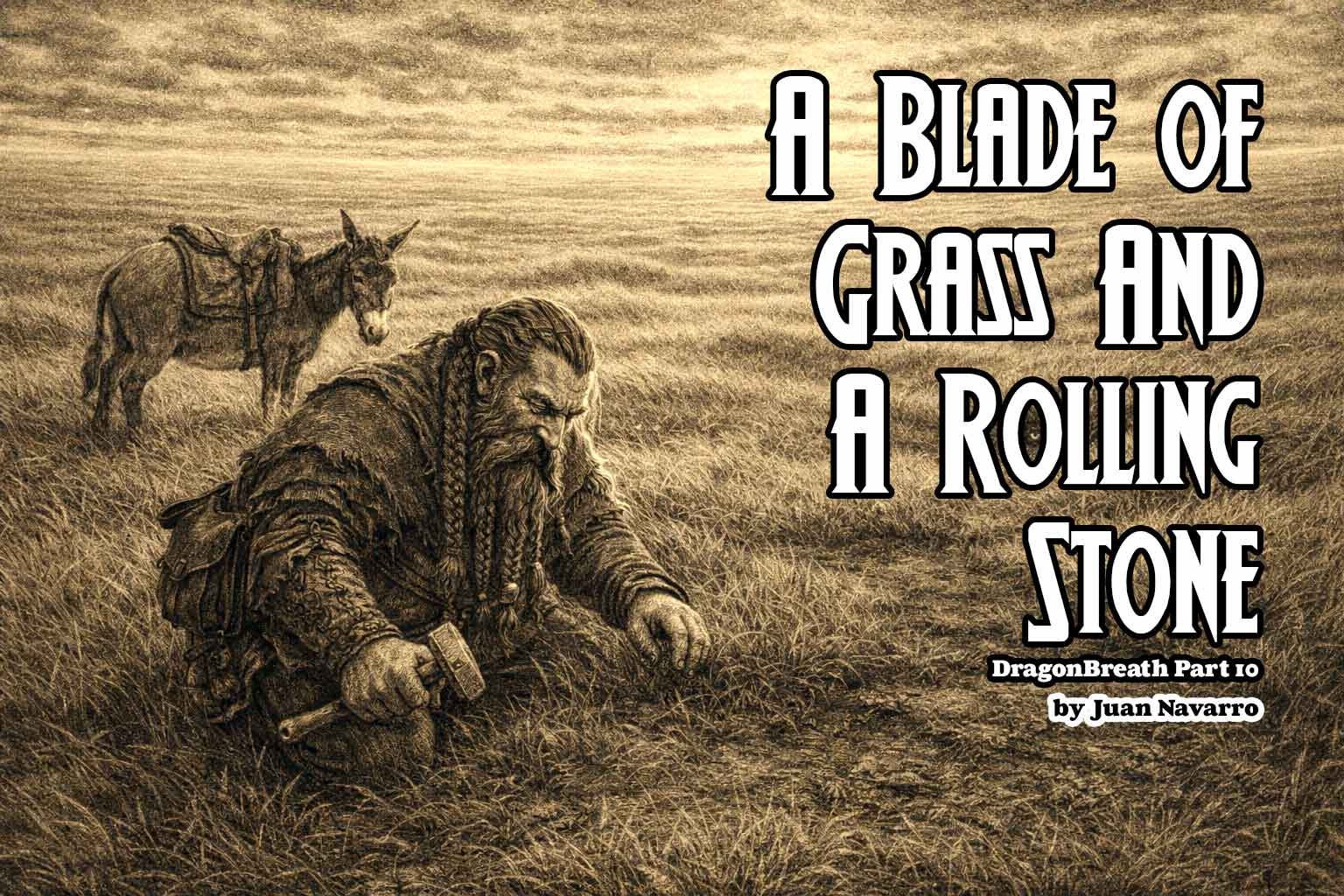
Three days outside the nearest town, Gaf sat beside a small fire that didn’t need to exist anymore, the Grass Spears stretching endlessly in every direction—green and gold waves rolling beneath a sky that never seemed to know when to stop. There were no mountains, no walls, no ceilings—no sense, if you asked Gaf. Up here, everything simply kept going until it got tired and turned into sky, and it made his teeth itch, like the world itself was daring him to bite back. He hadn’t bothered to name the feeling in years. He simply remembered it.
The wind slithered through the Grass Spears, seemingly whispering nonsense or wisdom, he could not tell.
It bent the land instead of crossing it—long green and gold waves rolling out like a sea that had misplaced its water, every blade flashing in the sun like a knife. At times, the grass was at your knee, and at others, it towered over your head. The sky above was too wide, too open. It made men feel small, and even gods glance over their shoulders.
Gaf preferred stone.
Stone did not move unless something terrible had happened.
He sat on his donkey, Berb, who chewed grass with the patience of a beast that had outlived more bad ideas than most kings, and probably judged every single one if you gave him the time.
“You smell that?” Gaf muttered.
Berb flicked an ear.
“Course you don’t. You eat anything. If the world ended tomorrow, you’d probably just ask for seconds.”
Gaf leaned forward, thick fingers sifting the air like he expected it to bite. A hundred and thirty-five years had taught him to trust suspicion over instinct every time.
The grass here was wrong. Not the kind of wrong you could see, but the kind that crawled up your boots and whispered in your ear.
Not dead. Not diseased. Just… arranged.
He nudged Berb to a stop.
There—three steps ahead—a dip in the earth, too neat to be honest. The grass over it trimmed just a little too close, like someone had given it a haircut with a dull knife and hoped the world wouldn’t notice.
“Mm.”
Gaf slid off the saddle with a grunt. His boots hit the ground with a dull thud, and he crouched low, running a hand over the earth.
Pit trap. Old as lies.
Covered well. Too well. The kind of care that meant trouble.
A good pit trap doesn’t look like anything at all—that’s the trick, that’s always been the trick—and most of the time it works because the world is lazy and people trust the ground beneath their feet more than they should. You dig it deep, not absurdly so, just enough that when a man drops in he feels the breath leave his body and the hope follow right after it—deep enough to break a leg clean or twist it wrong so climbing becomes a story he tells himself instead of something he can actually do. You line the bottom with stakes, not too many, not too neat, just enough to make the landing a negotiation between pain and panic, and if you’re serious—if you’ve done this before—you smear the tips in rot, shit, anything that festers, so even a shallow wound becomes a promise of something worse later. Then you cover it, light, careful, grass and dirt laid as a lie told well, and when it works—and it usually does—the victim doesn’t die right away, no, that’s not the point. They stay there, broken, pinned, hurting, making just enough noise to let the hunter find them again, nice and easy, so he can finish the job at his own pace, with arrows or a spear, like closing a tab he forgot he left open. Gaf knew traps because the world had always been full of them, some made of wood and some of silence or secrets. He trusted the ground beneath him about as far as he could throw it, and after all these years, every hidden danger felt more like a lesson than a hazard—proof that survival was about seeing what others refused to look for.
He grinned, couldn’t help it.
“Someone’s clever.”
Berb snorted.
“Aye, I know. Not as clever as you, eh?”
The donkey ignored him.
Gaf stood, gave the trap a wide berth, and tucked its edge away in his memory for later. Then he stopped, boots sinking into the grass like the earth was thinking about keeping him.
No.
Not just one.
He turned slowly, scanning the land.
There.
And there.
And—hah—there.
A line of them. Subtle, staggered, not the work of chance. Someone wanted to herd something, or someone, right into the wolf’s mouth.
Gaf’s grin stretched wider, all teeth and trouble.
“Well now,” he said softly. “That’s interesting.”
Remoz had been tracking the dwarf for the better part of an hour.
The halfling lay flat in the grass, just another ripple in a sea of them, his small frame swallowed by green and gold. Hair braided tight with grass and feathers, breaking up his shape. Bow in hand, arrow nocked, but not yet hungry for blood. He was a young but talented trapper; his job was to secure the land and make sure the green sea of grass remained, always there.
He watched the dwarf step cleanly around the third trap.
Remoz frowned.
“No,” he whispered. “No, no, no…”
The dwarf paused. Looked around.
Remoz froze.
There was a moment—just a flicker—where he felt as though the dwarf was looking straight at him.
Impossible.
The grass swallowed everything.
Still…
The dwarf moved again. Not forward. Sideways.
Avoiding the next trap.
Remoz’s frown deepened into something closer to irritation.
“That’s not how that works.”
Gaf scratched at his beard, which had collected half the prairie and a few secrets besides.
It was a thick beard, braided in three, iron rings etched with sigils only he could name. Dust, grass, and—somehow—a feather tangled in, as if the world itself was trying to claim him for its own.
He plucked the feather free and flicked it into the wind, a tiny surrender.
“Alright then,” he murmured. “Let’s see how far you’ve taken this.”
He stepped forward deliberately—then veered at the last second, avoiding a cleverly hidden snare that would have snapped tight around his ankle.
“Mmhm.”
Another step. Another shift.
A tension line stretched between two nearly invisible stakes—he stepped over it.
A pressure plate tucked under a rock—he nudged it with his boot. Barbed spikes snapped up ahead, eager and left wanting.
Gaf whistled low, impressed despite himself.
“Remind me to send you a thank-you note if I end up in one of these,” he muttered to Berb. “Or maybe you write it. Your penmanship’s better.”
Gaf thumbed the sharpened wood spike that had sprung up.
“Oh, I like you.”
Berb brayed softly behind him.
“Don’t start. You’d have walked right into the first one and asked for seconds.”
Remoz’s eye twitched.
He had placed that spike trap himself.
He had spent two days perfecting the tension, angle, and timing.
The dwarf had tested it.
Tested it.
Remoz sat up, patience coming apart like an old shirt.
“This is not how this goes,” he muttered. “You fall. I watch. Maybe I can help. Maybe I don’t. That’s the order of things.”
The dwarf was making a mess of the order of things.
Worse, he was picking up the pattern. Fast.
Remoz rose into a crouch and began to move.
Gaf stopped.
There it was again.
Not a sound. Not exactly.
A feeling, the kind that crawls up your spine and asks if you’re paying attention.
The grass moved differently in one direction. Against the wind.
He didn’t turn. Didn’t twitch. Just let his hand drift to his belt and loosen the small, blunt-headed hammer that had solved more problems than it started.
“Come on then,” he said under his breath. “Let’s meet properly.”
Remoz circled wide, moving low and fast. He knew this land. Every dip, every root, every hidden hollow. He could have crossed it blindfolded and still found his way home.
The dwarf was near the heart of the trap field now.
Remoz angled toward him, bow raised.
Not to kill.
Just to set things right. Or at least, his version of right.
He drew the string back, sighting along the shaft.
The dwarf stood still.
Too still.
Remoz hesitated.
Something was—
The dwarf moved.
Fast.
Too fast.
He turned—not toward the obvious direction—but toward Remoz.
Their eyes met.
“Ah,” the dwarf said. “There you are.”
Remoz loosed the arrow.
Gaf stepped aside.
Not quick. Not flashy. Just enough to make the arrow miss and the point clear.
The arrow passed him cleanly.
“Well,” Gaf said, turning all the way around. “That’s just rude.”
Remoz didn’t hesitate again.
He dropped the bow and rushed forward, drawing a short blade from his hip. Speed was his advantage. Size. Surprise.
He would take the dwarf low. Cut the leg. Bring him down.
He closed the distance in a heartbeat.
Gaf didn’t move.
Not until the last second.
Then he stepped forward.
Into the attack.
Remoz’s blade flashed upward—
—and met iron.
Gaf’s hammer met the blade with a dull clang, nudging it aside. His other hand shot out, grabbed Remoz by the collar, and yanked him forward like a sack of potatoes.
Remoz twisted, slipping free, rolling to the side—
—and nearly stepped into his own trap.
He caught himself at the last second, breath hitching.
Gaf laughed, a sound like gravel in a bucket.
“Oh, that’s beautiful.”
Remoz scowled. “You’re in my field.”
“And you’re in my way.”
They circled each other, grass hissing underfoot.
Grass whispered around them.
“You’re a long way from stone,” Remoz said.
Gaf shrugged. “Stone gets boring.”
“Does it?”
“No.”
Remoz blinked.
Gaf grinned. “But the things above it don’t.”
Remoz attacked again.
Faster this time. Lower.
Gaf met him, step for step—not with speed, but with the kind of anticipation that comes from too many years and too many scars. Every strike from Remoz found air, iron, or nothing at all. The dwarf moved with a stingy grace that bordered on rude.
He wasn’t stronger.
He was simply—damn him—right.
Remoz feinted left, then right, then dropped low—
Gaf stepped back—
Remoz lunged—
—and Gaf planted a boot square in his chest.
Remoz flew backward, landing hard, the breath knocked from him in a sharp grunt.
He rolled, came up on one knee—
—and froze.
Gaf loomed over him, hammer slung across his shoulder like he was posing for a statue no one would ever build.
“Done?” the dwarf asked, eyebrow raised.
Remoz glared up at him.
“…maybe.”
Gaf considered that.
Then he nodded.
“Good.”
He stepped back.
They stood in silence for a moment.
The wind moved through the grass again, as if nothing had happened.
Remoz hauled himself up, brushing dirt and pride from his clothes.
“You got past three of my traps,” he said.
“Five.”
Remoz frowned. “Five?”
Gaf jerked a thumb over his shoulder. “Missed two.”
Remoz turned.
He had.
“…damn it all.”
“What’s your name?” Gaf asked.
“Remoz.”
Gaf nodded. “Gaf.”
Remoz squinted. “Just Gaf?”
“Just Gaf.”
“…alright.”
They stood there a moment longer.
Then Remoz sighed.
“You’re not making it across the Spears alone.”
Gaf raised an eyebrow. “Seems I’ve done alright so far.”
“That’s a mile, maybe. The Spears go on for weeks. Out there, clever’s just another way to get lost.”
Gaf’s expression shifted slightly.
“Good,” he said.
Remoz blinked. “Good?”
“Aye. Means it’s worth the trip.”
Remoz stared at him for a long moment.
Then he laughed.
A sharp, sudden sound.
“You’re insane.”
Gaf nodded. “Been told.”
Remoz jerked his thumb toward the horizon.
“Come on then, Stone-Man,” he said. “Let’s see how long you last.”
Gaf swung back onto Berb, who gave him a look that said he’d been ignored long enough and would be filing a complaint.
“We’ll manage just fine,” Gaf said, mostly to reassure the donkey.
Remoz shook his head, already moving ahead, parting the grass like a ghost.
Gaf followed.
The grass closed over them, greedy and green, as if the Spears were hungry for stories and not too picky about the taste. Somewhere ahead, the wind shifted with a whisper that was almost a warning, and the land seemed to hush, waiting for something neither dwarf nor trapper could yet name.
Behind them, where no eyes watched, the land shifted in its sleep.
Far beneath the roots.
Far beneath memory.
Something old rolled over in the dark.
Not awake.
Not yet.
But listening, the way old things do: patient, and hungry.
And for the briefest moment—
The wind stopped.
You can read other Dragonbreath short stories here as we build to the Novel and serialized adventures soon! We post short stories almost every two weeks, so subscribe not to miss an episode!